Question 10
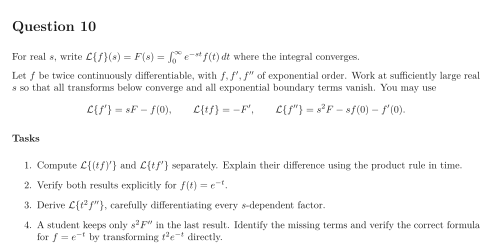
For real , write where the integral converges.
Let be twice continuously differentiable, with of exponential order. Work at sufficiently large real so that all transforms below converge and all exponential boundary terms vanish. You may use
Tasks
Compute and separately. Explain their difference using the product rule in time.
Verify both results explicitly for .
Derive , carefully differentiating every -dependent factor.
A student keeps only in the last result. Identify the missing terms and verify the correct formula for by transforming directly.
Show solutionHide solution
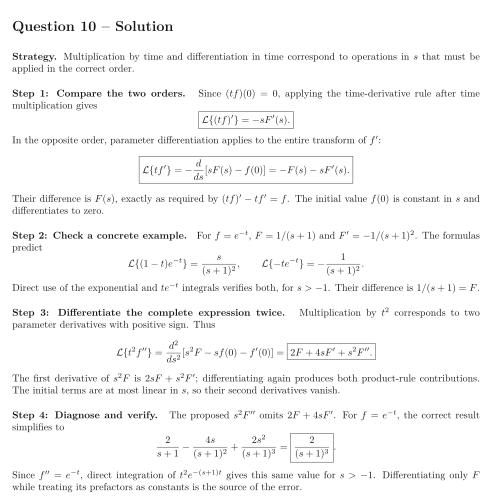
Question 10 – Solution
Strategy. Multiplication by time and differentiation in time correspond to operations in that must be applied in the correct order.
Step 1: Compare the two orders. Since , applying the time-derivative rule after time multiplication gives In the opposite order, parameter differentiation applies to the entire transform of : Their difference is , exactly as required by . The initial value is constant in and differentiates to zero.
Step 2: Check a concrete example. For , and . The formulas predict Direct use of the exponential and integrals verifies both, for . Their difference is .
Step 3: Differentiate the complete expression twice. Multiplication by corresponds to two parameter derivatives with positive sign. Thus The first derivative of is ; differentiating again produces both product-rule contributions. The initial terms are at most linear in , so their second derivatives vanish.
Step 4: Diagnose and verify. The proposed omits . For , the correct result simplifies to Since , direct integration of gives this same value for . Differentiating only while treating its prefactors as constants is the source of the error.