Question 5
Use the ordinary one-sided Laplace transform for real . Seek an inverse continuous on and of exponential order; transforms agreeing for all sufficiently large have at most one inverse in this class.
Consider the repeated quadratic factor You may use , and for .
Tasks
Derive the transform of by differentiating the cosine transform.
Find constants such that the inverse is . Verify the resulting rational numerator.
Show that the inverse is unbounded despite having no positive exponential factor. Give an explicit sequence witnessing growth.
Find its leading term near and its exact real convergence interval. Compare the local term with the large- scale .
Show solutionHide solution
Question 5 – Solution
Strategy. A repeated quadratic can be handled with parameter differentiation and linear combinations, without assuming a product rule for inverses.
Step 1: Produce the repeated denominator. Differentiating the cosine pair gives Polynomial factors times the damping kernel are integrable for , justifying the differentiation.
Step 2: Cancel the unwanted numerator. The transform of has numerator . Requiring it to equal one gives , , hence Substitution gives , verifying the numerator exactly. Inverting a product by multiplying inverses would not give this result.
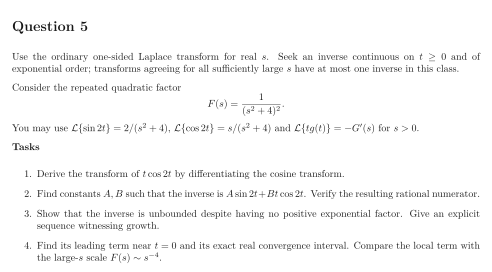
Step 3: Exhibit growth, not just an envelope. The bound is only an upper bound. Actual unboundedness follows from The factor produced by the repeated poles causes increasing oscillation size. The graph displays several oscillations at their actual scale.
Step 4: Check onset and convergence. Taylor expansion gives , so . Since , the initial scale agrees with . Absolute convergence holds for by the linear envelope. At , direct integration gives which has no limit. For , intervals near successive positive peaks of have eventually positive integrand of order ; their integrals fail the Cauchy criterion. Thus is exact.
See the diagram in the original worksheet below.