Question 4
Use one-sided Laplace transforms and retain all initial-value terms. Write , with real sufficiently large during the transformation. Unless stated otherwise, solve on .
An undamped oscillator starts at rest: Define its energy by .
Tasks
Derive and invert it. You may use .
Check the equation and both initial data directly.
Prove that the response is unbounded by evaluating a suitable explicit time sequence. State its exact real transform domain.
Derive the energy identity and calculate for positive integers . Explain why bounded forcing can supply unbounded accumulated energy.
Show solutionHide solution
Question 4 – Solution
Strategy. Matching forcing and natural frequencies produce repeated transform poles. Explicit values and the work identity distinguish real growth from a mere upper bound.
Step 1: Transform and invert. Zero initial data give Combining the sine pair with the supplied time-cosine pair yields Indeed the forward numerator is .
Step 2: Verify the IVP. Direct differentiation gives Adding gives . Both initial values are zero, proving the claimed solution by uniqueness.
Step 3: Exhibit unbounded values and the domain. At , The actual response is therefore unbounded; a growing envelope alone would not prove that. Its linear envelope gives absolute transform convergence for . At zero, its finite integral is , which has no limit. Below zero, intervals around successive peaks of the term violate the Cauchy criterion. Hence the exact domain is .
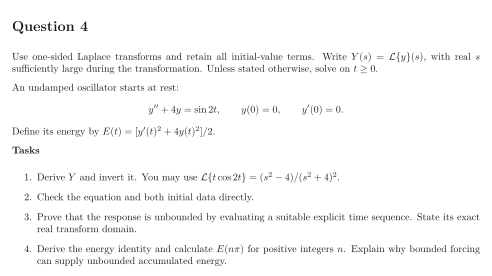
Step 4: Account for the energy input. Multiplying the equation by gives At , the velocity is zero, so Although the forcing amplitude is at most one, its work accumulates over an increasing time interval. Resonance makes that accumulated work unbounded. The graph shows the growing displacement oscillations, not the energy itself.
See the diagram in the original worksheet below.