Question 5
Use one-sided Laplace transforms and retain all initial-value terms. Write , with real sufficiently large during the transformation. Unless stated otherwise, solve on .
An unstable equation has adjustable initial velocity:
Tasks
Derive and invert for arbitrary real .
Find the unique that gives a bounded solution, and verify the resulting IVP.
If the chosen velocity is perturbed by , derive the exact error in the solution. Determine the largest allowed that guarantees an error at most for every .
State the exact transform domains for the bounded choice and for every other . Explain why the uncanceled operator factor alone does not determine the response domain.
Show solutionHide solution
Question 5 – Solution
Strategy. Initial data control the coefficient of the unstable mode. Exact cancellation can give a bounded trajectory but does not remove sensitivity to an initial error.
Step 1: Transform and resolve the modes. The transformed equation is Partial fractions give Recombining the fractions reproduces the transformed equation.
Step 2: Cancel the growing coefficient. Boundedness requires , so the unique choice is Then , , and . If the growing coefficient is nonzero, it eventually dominates both decaying terms, so no other velocity works.
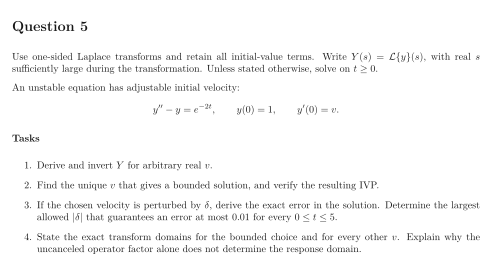
Step 3: Quantify the initial-error tolerance. Replacing by changes the solution by Since increases on , the maximum absolute error on is . The exact, necessary and sufficient tolerance is Equality is permitted and attains the error limit at time five. The graph compares the bounded choice with a small positive velocity error.
Step 4: Check the actual tails. For the bounded choice, the nonzero slow tail is , so the exact domain is . For every other , a nonzero term gives exact domain . The operator factor cancels from the selected response numerator. Its presence in the operator does not mean it survives in every solution; the initial data determine the residue.
See the diagram in the original worksheet below.