Question 9
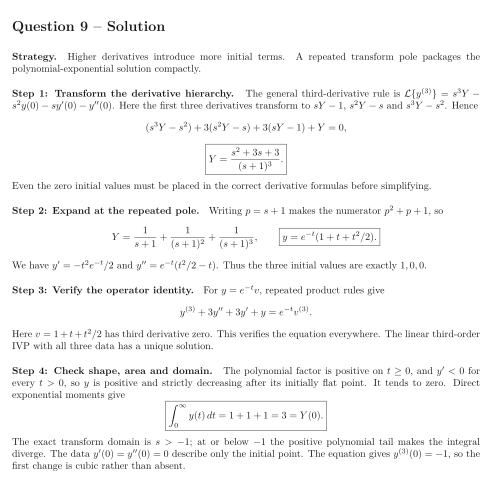
Use one-sided Laplace transforms and retain all initial-value terms. Write , with real sufficiently large during the transformation. Unless stated otherwise, solve on .
Use Laplace transforms for the third-order IVP
Tasks
Derive the transformed equation, displaying the contributions of all three initial data.
Invert the result at the repeated pole, and check all three data.
Verify the third-order differential equation directly, using if useful.
Prove positivity and strict decrease for . Compute the total integral and exact transform domain, and explain why the initial flatness does not make the solution constant.
Show solutionHide solution
Question 9 – Solution
Strategy. Higher derivatives introduce more initial terms. A repeated transform pole packages the polynomial-exponential solution compactly.
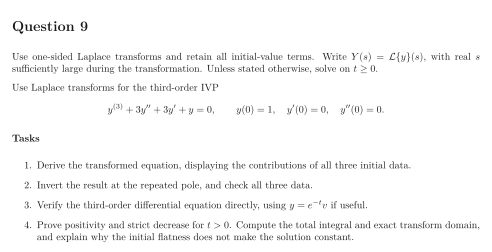
Step 1: Transform the derivative hierarchy. The general third-derivative rule is . Here the first three derivatives transform to , and . Hence Even the zero initial values must be placed in the correct derivative formulas before simplifying.
Step 2: Expand at the repeated pole. Writing makes the numerator , so We have and . Thus the three initial values are exactly .
Step 3: Verify the operator identity. For , repeated product rules give Here has third derivative zero. This verifies the equation everywhere. The linear third-order IVP with all three data has a unique solution.
Step 4: Check shape, area and domain. The polynomial factor is positive on , and for every , so is positive and strictly decreasing after its initially flat point. It tends to zero. Direct exponential moments give The exact transform domain is ; at or below the positive polynomial tail makes the integral diverge. The data describe only the initial point. The equation gives , so the first change is cubic rather than absent.