Question 9
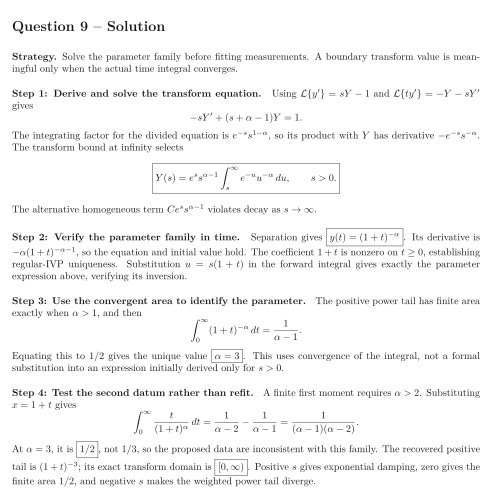
Use ordinary one-sided Laplace integrals for real . Where justified, write and use . Check existence and initial compatibility before treating a formal solution in as a transform.
An unknown parameter appears in An exact measurement gives . A second proposed measurement is .
Tasks
Derive the differential equation for and solve it as a convergent parameter integral for .
Identify and verify the time solution for general .
Determine which parameters admit a finite area, then recover from the first measurement.
Test the proposed first moment for consistency, and state the exact real transform domain of the recovered solution.
Show solutionHide solution
Question 9 – Solution
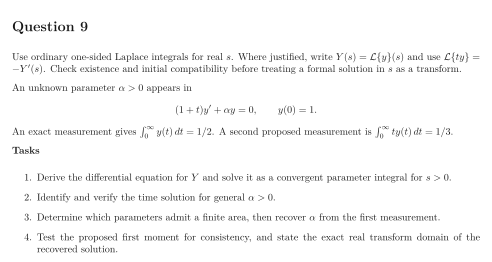
Strategy. Solve the parameter family before fitting measurements. A boundary transform value is meaningful only when the actual time integral converges.
Step 1: Derive and solve the transform equation. Using and gives The integrating factor for the divided equation is , so its product with has derivative . The transform bound at infinity selects The alternative homogeneous term violates decay as .
Step 2: Verify the parameter family in time. Separation gives . Its derivative is , so the equation and initial value hold. The coefficient is nonzero on , establishing regular-IVP uniqueness. Substitution in the forward integral gives exactly the parameter expression above, verifying its inversion.
Step 3: Use the convergent area to identify the parameter. The positive power tail has finite area exactly when , and then Equating this to gives the unique value . This uses convergence of the integral, not a formal substitution into an expression initially derived only for .
Step 4: Test the second datum rather than refit. A finite first moment requires . Substituting gives At , it is , not , so the proposed data are inconsistent with this family. The recovered positive tail is ; its exact transform domain is . Positive gives exponential damping, zero gives the finite area , and negative makes the weighted power tail diverge.