Question 10
Use ordinary one-sided Laplace integrals for real . Where justified, write and use . Check existence and initial compatibility before treating a formal solution in as a transform.
Choose constants so that a twice continuously differentiable solution on satisfies The equation must hold at the singular initial point as well as for .
Tasks
Derive the differential equation for without inserting unsupported free initial terms.
Solve it for general and select the branch that can be an ordinary transform.
Use the recovered time solution and the two initial conditions to determine . Verify the resulting equation at and away from zero.
Prove uniqueness in the stated smooth class, determine the exact transform domain, and describe the sign and monotonicity of the selected response.
Show solutionHide solution
Question 10 – Solution
Strategy. The data lost from the transform equation return as compatibility conditions on the forcing. Boundedness removes the singular time-domain homogeneous mode.
Step 1: Transform the time multipliers. The three left-hand terms transform to , and . Thus The initial value in differentiates to zero in . It must still be imposed on the inverse, not added back as a fictitious term.
Step 2: Solve and remove the inadmissible branch. Writing , divide by to obtain Integration gives Decay requires . The remaining terms invert to , whose transform can now be verified directly.
Step 3: Recover the forcing constants and verify. The initial value requires , and the initial slope requires . Hence Its derivative is , so At zero the equation gives , and both specified data hold. The smooth extension also has .
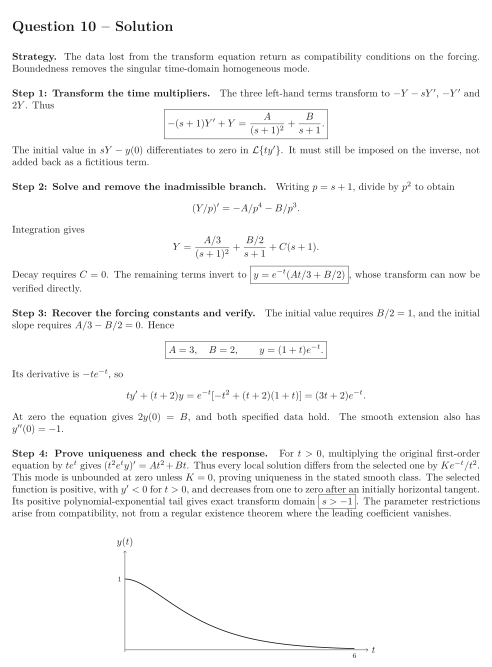
Step 4: Prove uniqueness and check the response. For , multiplying the original first-order equation by gives . Thus every local solution differs from the selected one by . This mode is unbounded at zero unless , proving uniqueness in the stated smooth class. The selected function is positive, with for , and decreases from one to zero after an initially horizontal tangent. Its positive polynomial-exponential tail gives exact transform domain . The parameter restrictions arise from compatibility, not from a regular existence theorem where the leading coefficient vanishes.
See the diagram in the original worksheet below.