Question 10
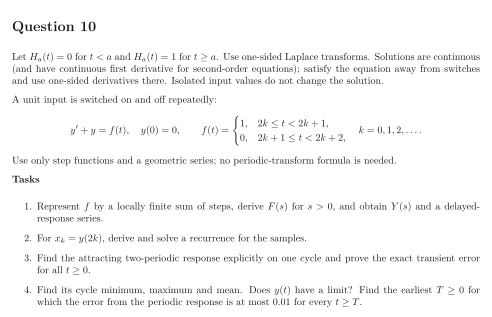
Let for and for . Use one-sided Laplace transforms. Solutions are continuous (and have continuous first derivative for second-order equations); satisfy the equation away from switches and use one-sided derivatives there. Isolated input values do not change the solution.
A unit input is switched on and off repeatedly: Use only step functions and a geometric series; no periodic-transform formula is needed.
Tasks
Represent by a locally finite sum of steps, derive for , and obtain and a delayed-response series.
For , derive and solve a recurrence for the samples.
Find the attracting two-periodic response explicitly on one cycle and prove the exact transient error for all .
Find its cycle minimum, maximum and mean. Does have a limit? Find the earliest for which the error from the periodic response is at most for every .
Show solutionHide solution
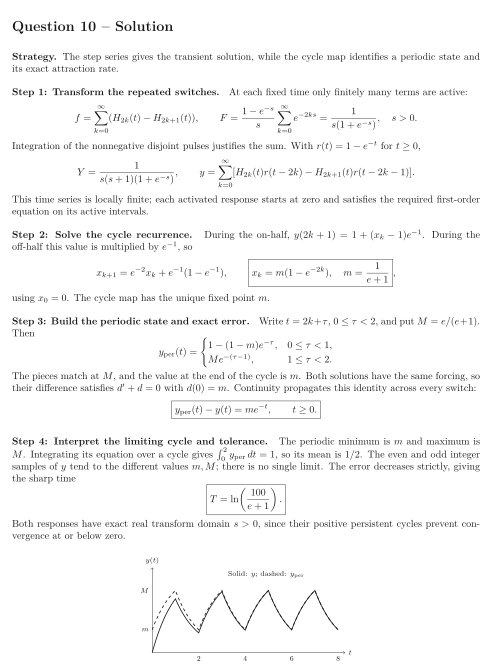
Question 10 – Solution
Strategy. The step series gives the transient solution, while the cycle map identifies a periodic state and its exact attraction rate.
Step 1: Transform the repeated switches. At each fixed time only finitely many terms are active: Integration of the nonnegative disjoint pulses justifies the sum. With for , This time series is locally finite; each activated response starts at zero and satisfies the required first-order equation on its active intervals.
Step 2: Solve the cycle recurrence. During the on-half, . During the off-half this value is multiplied by , so using . The cycle map has the unique fixed point .
Step 3: Build the periodic state and exact error. Write , , and put . Then The pieces match at , and the value at the end of the cycle is . Both solutions have the same forcing, so their difference satisfies with . Continuity propagates this identity across every switch:
Step 4: Interpret the limiting cycle and tolerance. The periodic minimum is and maximum is . Integrating its equation over a cycle gives , so its mean is . The even and odd integer samples of tend to the different values ; there is no single limit. The error decreases strictly, giving the sharp time Both responses have exact real transform domain , since their positive persistent cycles prevent convergence at or below zero.
See the diagram in the original worksheet below.