Question 6
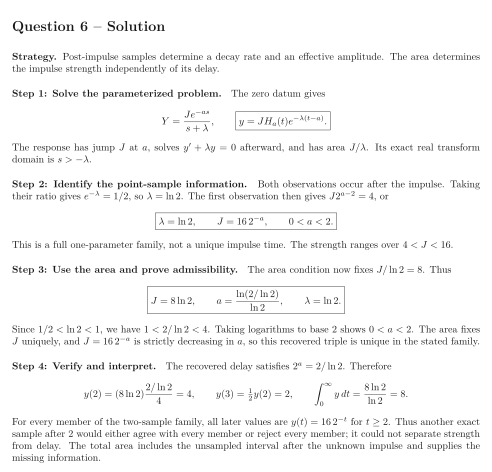
Use causal one-sided Laplace transforms. Write for and for . The unit impulse satisfies for continuous near . Interpret equations between impulses and through their jump conditions; use right-hand values at jumps. Write for a jump.
A single unknown impulse drives a first-order system: Exact observations give and . An additional measurement is the total response area .
Tasks
Derive the transform and response for general .
Use only the two point observations to determine what is identifiable. Parameterize every admissible triple consistent with them.
Use the area measurement to recover all three parameters uniquely, and verify the delay restriction.
Check all measurements directly and explain why the extra area measurement resolves an ambiguity that another later point sample would not.
Show solutionHide solution
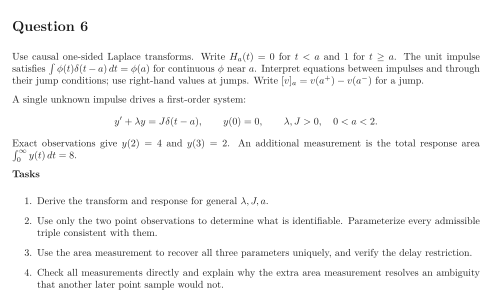
Question 6 – Solution
Strategy. Post-impulse samples determine a decay rate and an effective amplitude. The area determines the impulse strength independently of its delay.
Step 1: Solve the parameterized problem. The zero datum gives The response has jump at , solves afterward, and has area . Its exact real transform domain is .
Step 2: Identify the point-sample information. Both observations occur after the impulse. Taking their ratio gives , so . The first observation then gives , or This is a full one-parameter family, not a unique impulse time. The strength ranges over .
Step 3: Use the area and prove admissibility. The area condition now fixes . Thus Since , we have . Taking logarithms to base shows . The area fixes uniquely, and is strictly decreasing in , so this recovered triple is unique in the stated family.
Step 4: Verify and interpret. The recovered delay satisfies . Therefore For every member of the two-sample family, all later values are for . Thus another exact sample after would either agree with every member or reject every member; it could not separate strength from delay. The total area includes the unsampled interval after the unknown impulse and supplies the missing information.