Question 2
All functions are causal (zero for ). Use the one-sided Laplace transform and . Write for and for . Values at isolated endpoints do not affect an ordinary integral.
Two delayed rectangular pulses are and .
Tasks
Express as the length of an intersection of intervals, then derive a complete piecewise formula.
Find its transform and invert it as a sum of delayed ramps. Check agreement with the geometric formula.
Determine the support, all maximizing times, continuity, and the jumps of the first derivative.
Compute the area in two independent ways and give the exact real transform domain, including the value at .
Show solutionHide solution
Question 2 – Solution
Strategy. For unit-height rectangles, the integral measures overlap length.
Step 1: Track the overlap. Using commutativity, integrate . Both factors are on , so Endpoints of the intervals do not change their length.
Step 2: Transform and recover the ramps. For , The inverse is . Activating these four ramps successively gives slopes , exactly as in the piecewise formula.
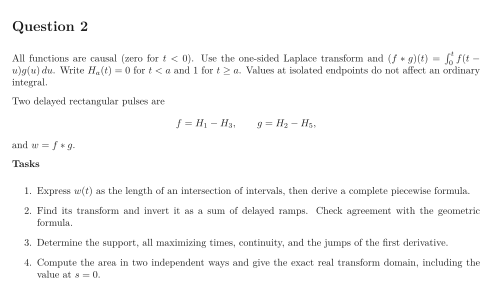
Step 3: Describe the geometry and regularity. The support (closure of the nonzero set) is ; precisely on . Its maximum is , attained at every . It is continuous everywhere. The first derivative has jumps at , respectively, and is undefined there in the ordinary two-sided sense.
Step 4: Check area and convergence. Two triangles and the plateau have total area . Independently, the convolution area is , by integrating over the rectangle in the two integration variables. Compact support makes the transform finite for every real . The displayed expression has removable value .
See the diagram in the original worksheet below.