Question 4
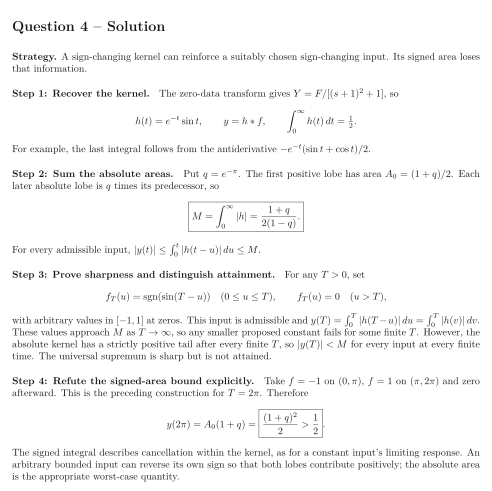
All functions are causal (zero for ). Use the one-sided Laplace transform and . Write for and for . Values at isolated endpoints do not affect an ordinary integral.
Let be real and piecewise continuous on each finite interval, with . Consider We seek the smallest constant such that for every admissible input and every .
Tasks
Find the impulse-response kernel and express by convolution. Compute .
Compute exactly by summing half-periods, and prove it is a uniform response bound.
Construct an input attaining at any prescribed . Prove that your uniform bound is sharp, and decide whether it can be attained at a finite time.
Give an explicit two-level input on whose response at exceeds . Explain the error in using the signed kernel integral as the universal bound.
Show solutionHide solution
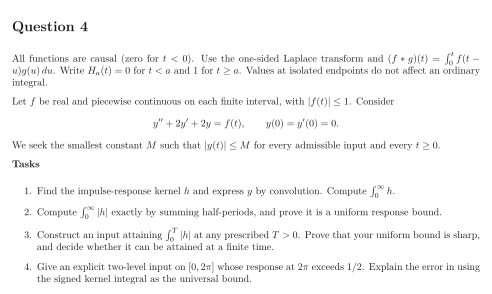
Question 4 – Solution
Strategy. A sign-changing kernel can reinforce a suitably chosen sign-changing input. Its signed area loses that information.
Step 1: Recover the kernel. The zero-data transform gives , so For example, the last integral follows from the antiderivative .
Step 2: Sum the absolute areas. Put . The first positive lobe has area . Each later absolute lobe is times its predecessor, so For every admissible input, .
Step 3: Prove sharpness and distinguish attainment. For any , set with arbitrary values in at zeros. This input is admissible and . These values approach as , so any smaller proposed constant fails for some finite . However, the absolute kernel has a strictly positive tail after every finite , so for every input at every finite time. The universal supremum is sharp but is not attained.
Step 4: Refute the signed-area bound explicitly. Take on , on and zero afterward. This is the preceding construction for . Therefore The signed integral describes cancellation within the kernel, as for a constant input’s limiting response. An arbitrary bounded input can reverse its own sign so that both lobes contribute positively; the absolute area is the appropriate worst-case quantity.