Question 5
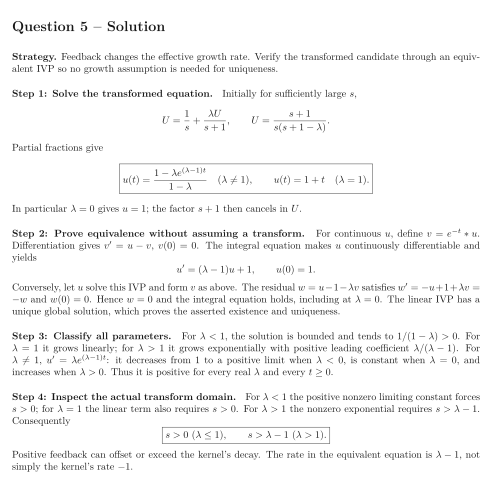
All functions are causal (zero for ). Use the one-sided Laplace transform and . Write for and for . Values at isolated endpoints do not affect an ordinary integral.
For a real parameter , solve the Volterra integral equation Seek a continuous solution on the entire half-line.
Tasks
Use transforms to derive the solution, treating every exceptional parameter value explicitly.
Derive an equivalent first-order IVP and prove the converse implication, establishing uniqueness among continuous solutions.
Classify boundedness, positivity and long-time behavior for all real , including .
Give the exact real transform domain in every case. Explain why exponential decay of the memory kernel does not by itself guarantee a bounded solution.
Show solutionHide solution
Question 5 – Solution
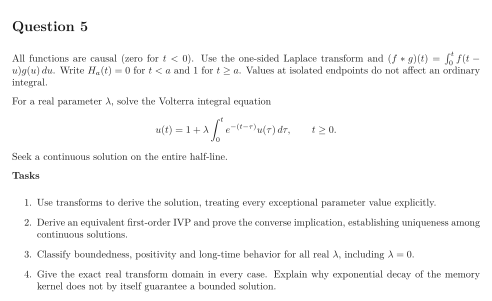
Strategy. Feedback changes the effective growth rate. Verify the transformed candidate through an equivalent IVP so no growth assumption is needed for uniqueness.
Step 1: Solve the transformed equation. Initially for sufficiently large , Partial fractions give In particular gives ; the factor then cancels in .
Step 2: Prove equivalence without assuming a transform. For continuous , define . Differentiation gives , . The integral equation makes continuously differentiable and yields Conversely, let solve this IVP and form as above. The residual satisfies and . Hence and the integral equation holds, including at . The linear IVP has a unique global solution, which proves the asserted existence and uniqueness.
Step 3: Classify all parameters. For , the solution is bounded and tends to . For it grows linearly; for it grows exponentially with positive leading coefficient . For , : it decreases from to a positive limit when , is constant when , and increases when . Thus it is positive for every real and every .
Step 4: Inspect the actual transform domain. For the positive nonzero limiting constant forces ; for the linear term also requires . For the nonzero exponential requires . Consequently Positive feedback can offset or exceed the kernel’s decay. The rate in the equivalent equation is , not simply the kernel’s rate .