Question 1
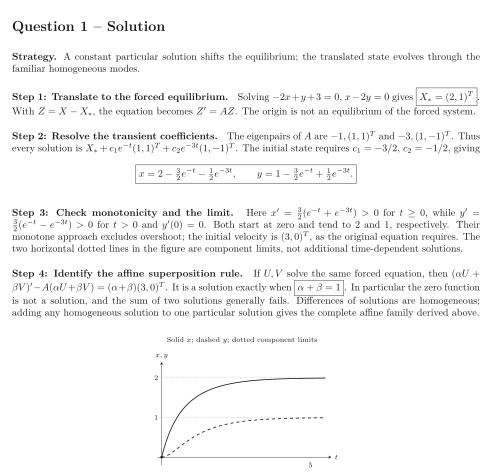
Consider the constant-input system Separate the equilibrium response from the transient response.
Tasks
Find the equilibrium and transform the equation into a homogeneous system by translating the state.
Use the homogeneous eigenmodes to find the complete family, then solve the stated IVP.
Determine whether either component overshoots its equilibrium value for . Give the limiting state and justify the signs of the derivatives.
Explain why the nonhomogeneous solution family is not a vector space. Which linear combinations of two solutions necessarily solve the same forced equation?
Show solutionHide solution
Question 1 – Solution
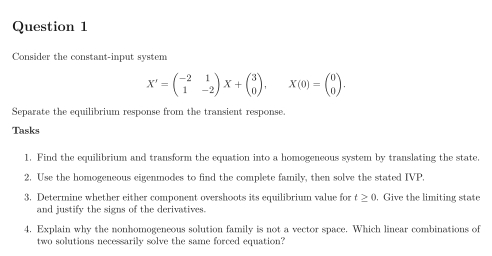
Strategy. A constant particular solution shifts the equilibrium; the translated state evolves through the familiar homogeneous modes.
Step 1: Translate to the forced equilibrium. Solving , gives . With , the equation becomes . The origin is not an equilibrium of the forced system.
Step 2: Resolve the transient coefficients. The eigenpairs of are and . Thus every solution is . The initial state requires , , giving
Step 3: Check monotonicity and the limit. Here for , while for and . Both start at zero and tend to and , respectively. Their monotone approach excludes overshoot; the initial velocity is , as the original equation requires. The two horizontal dotted lines in the figure are component limits, not additional time-dependent solutions.
Step 4: Identify the affine superposition rule. If solve the same forced equation, then . It is a solution exactly when . In particular the zero function is not a solution, and the sum of two solutions generally fails. Differences of solutions are homogeneous; adding any homogeneous solution to one particular solution gives the complete affine family derived above.
See the diagram in the original worksheet below.