Question 2
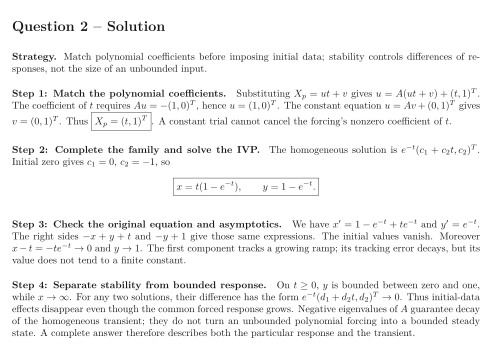
Let Both homogeneous eigenvalues are negative, but the forcing has an unbounded component. Use a polynomial particular solution.
Tasks
Find a particular solution of the form , with constant vectors . Explain why a constant trial cannot suffice.
Add the complete homogeneous family and impose the initial data.
Verify the result in the original equations and determine the limits of and .
Decide which components are bounded and whether two solutions with different initial data approach one another. Explain why homogeneous stability does not force convergence to a constant here.
Show solutionHide solution
Question 2 – Solution
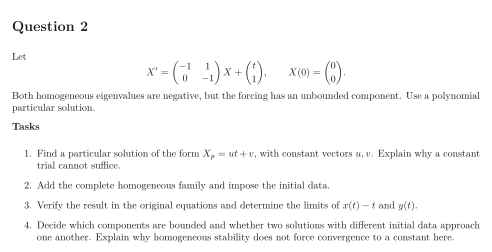
Strategy. Match polynomial coefficients before imposing initial data; stability controls differences of responses, not the size of an unbounded input.
Step 1: Match the polynomial coefficients. Substituting gives . The coefficient of requires , hence . The constant equation gives . Thus . A constant trial cannot cancel the forcing’s nonzero coefficient of .
Step 2: Complete the family and solve the IVP. The homogeneous solution is . Initial zero gives , , so
Step 3: Check the original equation and asymptotics. We have and . The right sides and give those same expressions. The initial values vanish. Moreover and . The first component tracks a growing ramp; its tracking error decays, but its value does not tend to a finite constant.
Step 4: Separate stability from bounded response. On , is bounded between zero and one, while . For any two solutions, their difference has the form . Thus initial-data effects disappear even though the common forced response grows. Negative eigenvalues of guarantee decay of the homogeneous transient; they do not turn an unbounded polynomial forcing into a bounded steady state. A complete answer therefore describes both the particular response and the transient.