Question 2
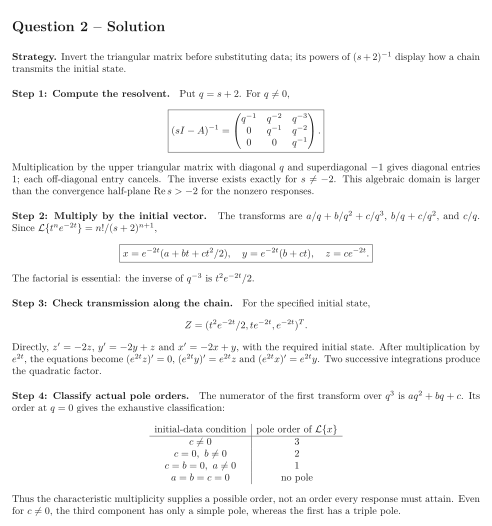
Let satisfy for , where The characteristic polynomial has a triple root. Investigate how the initial vector determines the poles actually present in each transformed component.
Tasks
Compute directly, and verify its product with is . State where the inverse matrix exists.
Use the resolvent to find all three Laplace transforms and invert them for arbitrary real .
For the initial state , verify the original equations and explain the different polynomial degrees in the three components.
Classify the pole order of at for every , including the case of no pole. Does a triple characteristic root force a triple pole in every component?
Show solutionHide solution
Question 2 – Solution
Strategy. Invert the triangular matrix before substituting data; its powers of display how a chain transmits the initial state.
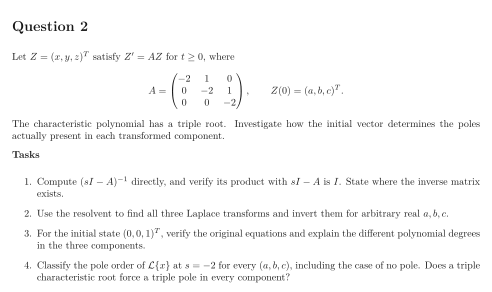
Step 1: Compute the resolvent. Put . For , Multiplication by the upper triangular matrix with diagonal and superdiagonal gives diagonal entries ; each off-diagonal entry cancels. The inverse exists exactly for . This algebraic domain is larger than the convergence half-plane for the nonzero responses.
Step 2: Multiply by the initial vector. The transforms are , , and . Since , The factorial is essential: the inverse of is .
Step 3: Check transmission along the chain. For the specified initial state, Directly, , and , with the required initial state. After multiplication by , the equations become , and . Two successive integrations produce the quadratic factor.
Step 4: Classify actual pole orders. The numerator of the first transform over is . Its order at gives the exhaustive classification: Thus the characteristic multiplicity supplies a possible order, not an order every response must attain. Even for , the third component has only a simple pole, whereas the first has a triple pole.