Question 10
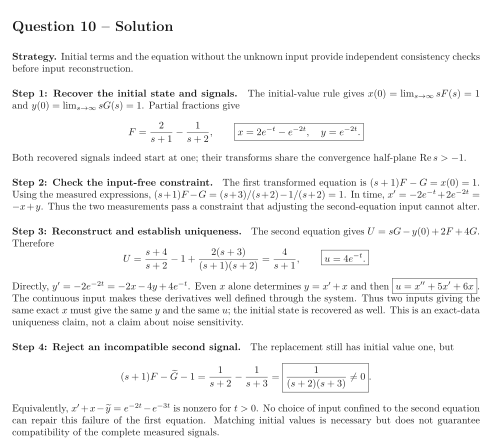
A known system has an unknown continuous input and unknown initial state: The input and states are of exponential order. A proposed pair of measured one-sided transforms is Assess compatibility before trying to infer the input.
Tasks
Recover both initial values from the transforms using the initial-value rule, then invert and .
Check the first transformed equation, including its initial term, and verify the corresponding time-domain equation.
Recover and from the second equation. Prove whether knowledge of alone would determine both and under the stated assumptions.
Suppose is unchanged but the proposed second transform is instead . Can any continuous input in the second equation repair the discrepancy? Quantify the violated transformed identity.
Show solutionHide solution
Question 10 – Solution
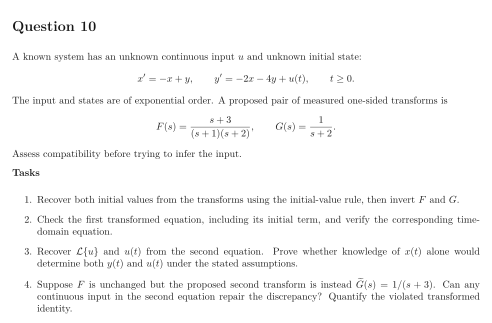
Strategy. Initial terms and the equation without the unknown input provide independent consistency checks before input reconstruction.
Step 1: Recover the initial state and signals. The initial-value rule gives and . Partial fractions give Both recovered signals indeed start at one; their transforms share the convergence half-plane .
Step 2: Check the input-free constraint. The first transformed equation is . Using the measured expressions, . In time, . Thus the two measurements pass a constraint that adjusting the second-equation input cannot alter.
Step 3: Reconstruct and establish uniqueness. The second equation gives . Therefore Directly, . Even alone determines and then . The continuous input makes these derivatives well defined through the system. Thus two inputs giving the same exact must give the same and the same ; the initial state is recovered as well. This is an exact-data uniqueness claim, not a claim about noise sensitivity.
Step 4: Reject an incompatible second signal. The replacement still has initial value one, but Equivalently, is nonzero for . No choice of input confined to the second equation can repair this failure of the first equation. Matching initial values is necessary but does not guarantee compatibility of the complete measured signals.