Question 7
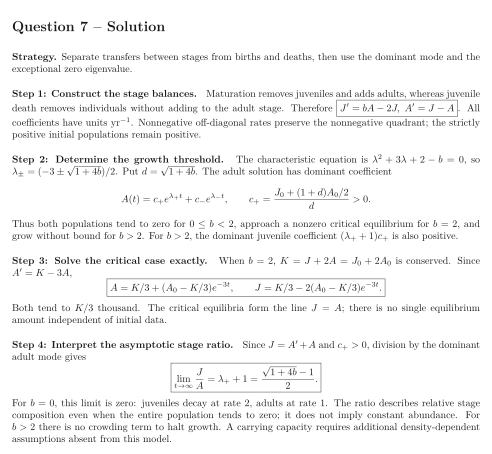
A continuous two-stage population model uses juvenile and adult abundances , measured in thousands, with time in years. Juveniles mature at per-capita rate yr and die at rate yr. Adults die at rate yr and produce juveniles at per-capita rate yr, where . Assume no crowding and strictly positive initial .
Tasks
Derive the stage equations and explain why maturation must appear with opposite signs in the two balances.
Find the eigenvalues and classify long-time extinction, a critical threshold, and unbounded growth as varies. Justify that the growing mode is actually present for the stated initial data.
At the critical value, find a conserved weighted total, the exact solution and its limiting stage abundances.
For every , find the limiting ratio and interpret it. Explain why this linear model cannot determine a realistic carrying capacity.
Show solutionHide solution
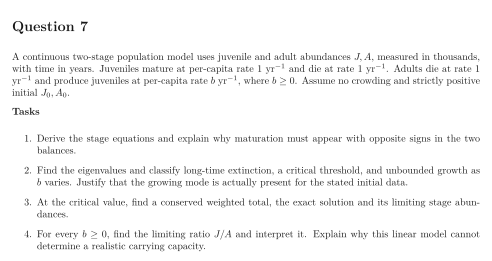
Question 7 – Solution
Strategy. Separate transfers between stages from births and deaths, then use the dominant mode and the exceptional zero eigenvalue.
Step 1: Construct the stage balances. Maturation removes juveniles and adds adults, whereas juvenile death removes individuals without adding to the adult stage. Therefore . All coefficients have units yr. Nonnegative off-diagonal rates preserve the nonnegative quadrant; the strictly positive initial populations remain positive.
Step 2: Determine the growth threshold. The characteristic equation is , so . Put . The adult solution has dominant coefficient Thus both populations tend to zero for , approach a nonzero critical equilibrium for , and grow without bound for . For , the dominant juvenile coefficient is also positive.
Step 3: Solve the critical case exactly. When , is conserved. Since , Both tend to thousand. The critical equilibria form the line ; there is no single equilibrium amount independent of initial data.
Step 4: Interpret the asymptotic stage ratio. Since and , division by the dominant adult mode gives For , this limit is zero: juveniles decay at rate , adults at rate . The ratio describes relative stage composition even when the entire population tends to zero; it does not imply constant abundance. For there is no crowding term to halt growth. A carrying capacity requires additional density-dependent assumptions absent from this model.