Question 2
Work with real matrices and column vectors. Write for the identity, for transpose, and for Euclidean length. Show the reasoning behind every classification; do not use eigenvalue methods.
In the plane, apply the shear and quarter-turn Composition acts on column vectors from right to left.
Tasks
Compute and . Apply each to and explain the difference in operation order.
Find every vector for which . Prove that your list is complete.
Find by reversing the operations, and verify the inverse by multiplication.
Map the four vertices of the unit square in their cyclic order under both products. Compare areas and orientation, and explain why equal determinants do not imply equal transformations.
Show solutionHide solution
Question 2 – Solution
Strategy. Matrix multiplication records the order of geometric operations. Determinants retain only part of that information.
Step 1: Compute both compositions. Direct multiplication gives Thus and . The first shears then rotates; the second rotates then shears.
Step 2: Test agreement on an arbitrary vector. Subtracting gives This is zero exactly when . Therefore the two compositions agree only on the zero vector, despite each being invertible.
Step 3: Undo the operations in reverse order. Since and , Multiplication with on either side gives .
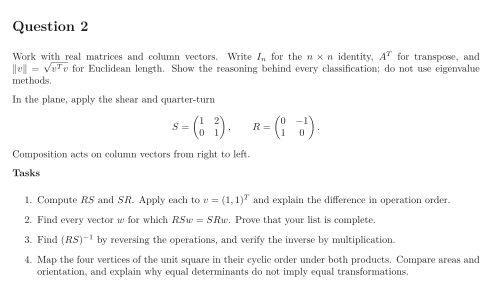
Step 4: Compare the images of the square. For vertices in that order, the images are Both determinants are , so both images have area and preserve the counterclockwise orientation. The parallelograms nevertheless differ. A determinant encodes signed area scaling, not the full image of each vector. The plot uses equal scales on both axes.
See the diagram in the original worksheet below.