Question 4
Work with real matrices and column vectors. Write for the identity, for transpose, and for Euclidean length. Show the reasoning behind every classification; do not use eigenvalue methods.
Use the ordered basis , of the plane. Let have columns , so a coordinate column represents the physical vector . A transformation in standard coordinates is
Tasks
Find and the coordinates of in the ordered basis.
Derive the matrix representing in this basis, explaining the order of all three operations.
Apply the coordinate matrix to your coordinate column and check the result against direct standard-coordinate multiplication.
For arbitrary coordinate columns, derive the relation between coordinate length and physical length. Compare the determinants of the two representations and interpret the physical area factor.
Show solutionHide solution
Question 4 – Solution
Strategy. A vector and its coordinate column describe the same object in different languages. Convert in the correct order.
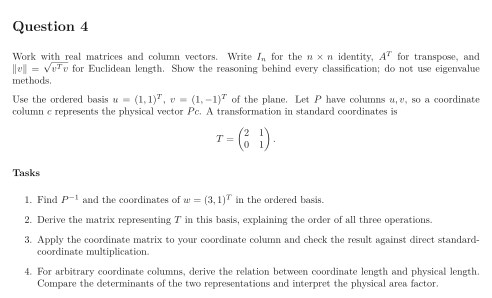
Step 1: Build and invert the basis matrix. Here Thus , as the figure illustrates.
Step 2: Express the transformation in the new coordinates. Start with a coordinate column . Convert it to , apply , and convert the result back with . Consequently
Step 3: Verify both routes. The coordinate route gives , representing . Directly, as well. Equivalently, verifies the agreement for every input, not only .
Step 4: Compare lengths and area factors. Since , The basis vectors are perpendicular but have length , so physical length is times coordinate length. Also . The physical transformation doubles areas and preserves orientation, regardless of which basis is used to describe it. The negative determinant of describes the basis orientation; it does not change this area factor.
See the diagram in the original worksheet below.