Question 5
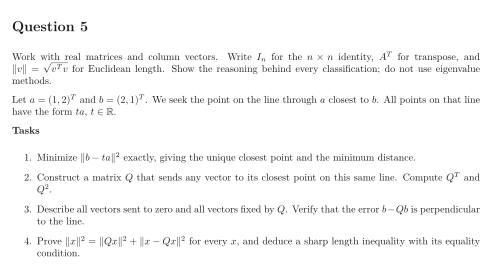
Work with real matrices and column vectors. Write for the identity, for transpose, and for Euclidean length. Show the reasoning behind every classification; do not use eigenvalue methods.
Let and . We seek the point on the line through closest to . All points on that line have the form , .
Tasks
Minimize exactly, giving the unique closest point and the minimum distance.
Construct a matrix that sends any vector to its closest point on this same line. Compute and .
Describe all vectors sent to zero and all vectors fixed by . Verify that the error is perpendicular to the line.
Prove for every , and deduce a sharp length inequality with its equality condition.
Show solutionHide solution
Question 5 – Solution
Strategy. Complete the square to find the best coefficient, then express that coefficient as a linear function of the input.
Step 1: Minimize the distance. Using , and , The unique minimizer is , so
Step 2: Build the projection matrix. For any input , the minimizing coefficient is . Therefore The last equality follows from .
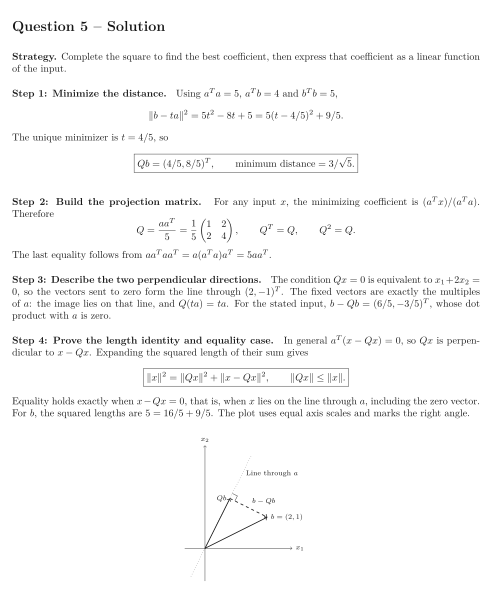
Step 3: Describe the two perpendicular directions. The condition is equivalent to , so the vectors sent to zero form the line through . The fixed vectors are exactly the multiples of : the image lies on that line, and . For the stated input, , whose dot product with is zero.
Step 4: Prove the length identity and equality case. In general , so is perpendicular to . Expanding the squared length of their sum gives Equality holds exactly when , that is, when lies on the line through , including the zero vector. For , the squared lengths are . The plot uses equal axis scales and marks the right angle.
See the diagram in the original worksheet below.