Question 9
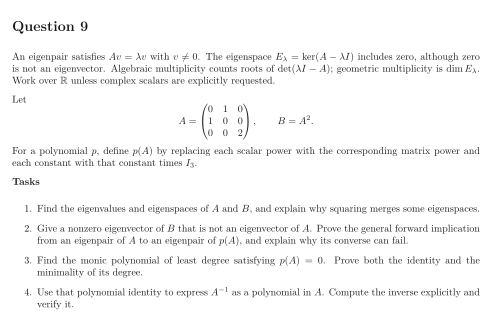
An eigenpair satisfies with . The eigenspace includes zero, although zero is not an eigenvector. Algebraic multiplicity counts roots of ; geometric multiplicity is . Work over unless complex scalars are explicitly requested.
Let For a polynomial , define by replacing each scalar power with the corresponding matrix power and each constant with that constant times .
Tasks
Find the eigenvalues and eigenspaces of and , and explain why squaring merges some eigenspaces.
Give a nonzero eigenvector of that is not an eigenvector of . Prove the general forward implication from an eigenpair of to an eigenpair of , and explain why its converse can fail.
Find the monic polynomial of least degree satisfying . Prove both the identity and the minimality of its degree.
Use that polynomial identity to express as a polynomial in . Compute the inverse explicitly and verify it.
Show solutionHide solution
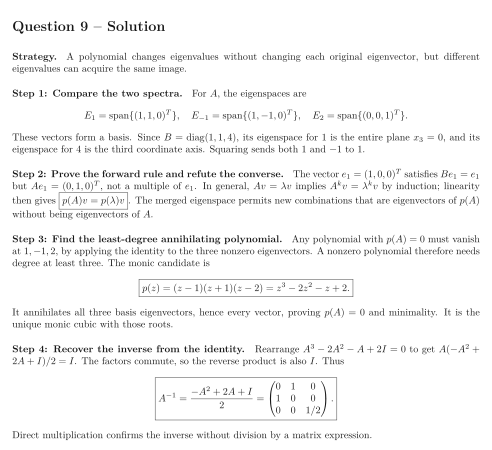
Question 9 – Solution
Strategy. A polynomial changes eigenvalues without changing each original eigenvector, but different eigenvalues can acquire the same image.
Step 1: Compare the two spectra. For , the eigenspaces are These vectors form a basis. Since , its eigenspace for is the entire plane , and its eigenspace for is the third coordinate axis. Squaring sends both and to .
Step 2: Prove the forward rule and refute the converse. The vector satisfies but , not a multiple of . In general, implies by induction; linearity then gives . The merged eigenspace permits new combinations that are eigenvectors of without being eigenvectors of .
Step 3: Find the least-degree annihilating polynomial. Any polynomial with must vanish at , by applying the identity to the three nonzero eigenvectors. A nonzero polynomial therefore needs degree at least three. The monic candidate is It annihilates all three basis eigenvectors, hence every vector, proving and minimality. It is the unique monic cubic with those roots.
Step 4: Recover the inverse from the identity. Rearrange to get . The factors commute, so the reverse product is also . Thus Direct multiplication confirms the inverse without division by a matrix expression.