Question 10
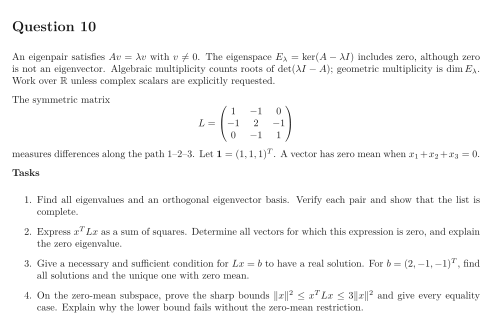
An eigenpair satisfies with . The eigenspace includes zero, although zero is not an eigenvector. Algebraic multiplicity counts roots of ; geometric multiplicity is . Work over unless complex scalars are explicitly requested.
The symmetric matrix measures differences along the path ––. Let . A vector has zero mean when .
Tasks
Find all eigenvalues and an orthogonal eigenvector basis. Verify each pair and show that the list is complete.
Express as a sum of squares. Determine all vectors for which this expression is zero, and explain the zero eigenvalue.
Give a necessary and sufficient condition for to have a real solution. For , find all solutions and the unique one with zero mean.
On the zero-mean subspace, prove the sharp bounds and give every equality case. Explain why the lower bound fails without the zero-mean restriction.
Show solutionHide solution
Question 10 – Solution
Strategy. Separate the constant direction, which the matrix cannot detect, from the two directions of variation.
Step 1: Verify a complete orthogonal basis. Direct multiplication gives The three vectors are nonzero and mutually perpendicular, so they form a basis of . Thus the complete eigenvalue list is , with the corresponding one-dimensional eigenspaces.
Step 2: Interpret the nonnegative quadratic form. Expanding gives It vanishes exactly when , the constant direction. The zero eigenvalue reflects the fact that adding the same constant to all three entries changes no adjacent difference.
Step 3: Solve subject to the compatibility condition. Since , solvability requires . Conversely, every such can be written , and solves the system for every real . For the stated , dot products give and . Therefore all solutions are The displayed particular vector has zero mean; the total sum is , so zero mean uniquely selects .
Step 4: Prove the sharp restricted bounds. A zero-mean vector has form . Orthogonality and , give The lower equality holds exactly on the line through ; the upper exactly on the line through , with zero included in both. This proves both sharp bounds. A nonzero constant vector has positive length but zero quadratic form, so the lower bound cannot hold on all of .
See the diagram in the original worksheet below.
