Question 4
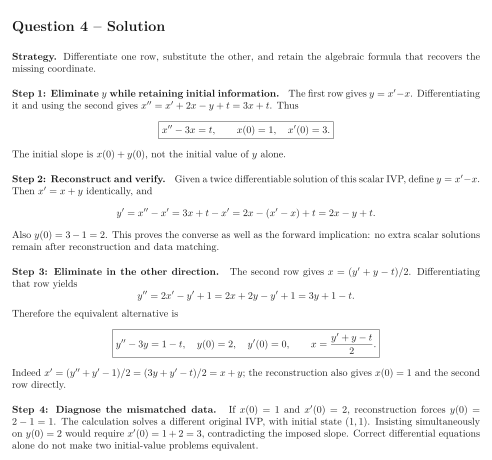
Consider the first-order system on the real time axis An equivalent scalar equation must preserve both the dynamics and the initial information; an eliminated coordinate must be recoverable.
Tasks
Eliminate to derive a second-order equation for . Find the two corresponding initial values.
Prove the converse: from any solution of your scalar IVP, reconstruct and verify both original equations and both original initial values.
Instead eliminate to obtain a scalar IVP for and a reconstruction formula for . Verify the forcing signs.
A calculation uses the correct scalar equation for but imposes , . Identify exactly which original initial condition this changes. Explain why prescribing both and the original is inconsistent.
Show solutionHide solution
Question 4 – Solution
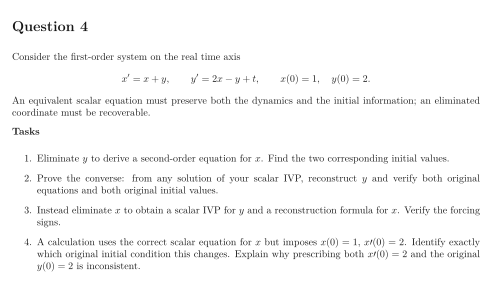
Strategy. Differentiate one row, substitute the other, and retain the algebraic formula that recovers the missing coordinate.
Step 1: Eliminate while retaining initial information. The first row gives . Differentiating it and using the second gives . Thus The initial slope is , not the initial value of alone.
Step 2: Reconstruct and verify. Given a twice differentiable solution of this scalar IVP, define . Then identically, and Also . This proves the converse as well as the forward implication: no extra scalar solutions remain after reconstruction and data matching.
Step 3: Eliminate in the other direction. The second row gives . Differentiating that row yields Therefore the equivalent alternative is Indeed ; the reconstruction also gives and the second row directly.
Step 4: Diagnose the mismatched data. If and , reconstruction forces . The calculation solves a different original IVP, with initial state . Insisting simultaneously on would require , contradicting the imposed slope. Correct differential equations alone do not make two initial-value problems equivalent.