Question 5
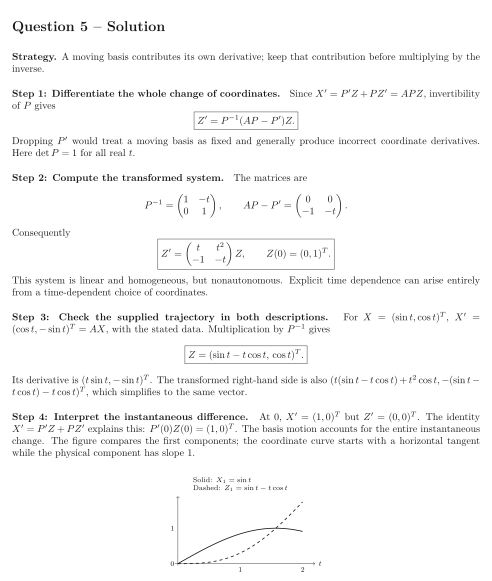
Let and introduce a time-dependent coordinate system , where The physical state and its coordinate column describe the same vector using different bases at different times.
Tasks
Derive the differential equation for by differentiating . Explain why the constant-basis formula is insufficient.
Compute the coefficient matrix and initial state for . Classify the transformed system as linear, homogeneous, and autonomous or nonautonomous.
Verify the supplied physical trajectory . Obtain and check both transformed equations directly.
Compare with . Explain how a zero instantaneous coordinate derivative can coexist with a changing physical vector.
Show solutionHide solution
Question 5 – Solution
Strategy. A moving basis contributes its own derivative; keep that contribution before multiplying by the inverse.
Step 1: Differentiate the whole change of coordinates. Since , invertibility of gives Dropping would treat a moving basis as fixed and generally produce incorrect coordinate derivatives. Here for all real .
Step 2: Compute the transformed system. The matrices are Consequently This system is linear and homogeneous, but nonautonomous. Explicit time dependence can arise entirely from a time-dependent choice of coordinates.
Step 3: Check the supplied trajectory in both descriptions. For , , with the stated data. Multiplication by gives Its derivative is . The transformed right-hand side is also , which simplifies to the same vector.
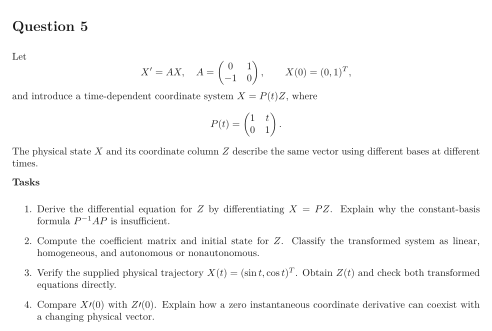
Step 4: Interpret the instantaneous difference. At , but . The identity explains this: . The basis motion accounts for the entire instantaneous change. The figure compares the first components; the coordinate curve starts with a horizontal tangent while the physical component has slope .
See the diagram in the original worksheet below.