Question 10
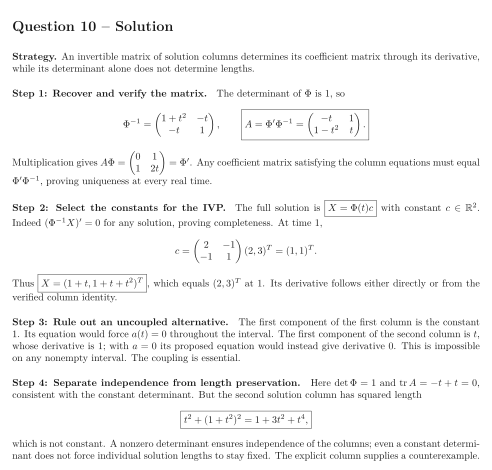
An unknown continuous homogeneous linear system has the two specified solution columns We ask whether these columns determine a unique system , rather than assuming that a displayed pair automatically comes from a chosen matrix.
Tasks
Find and verify . Prove uniqueness of the recovered coefficient matrix at every real time.
Write the complete solution family and solve the IVP . Verify the recovered initial state.
Could both columns instead solve an uncoupled system , on any nonempty open interval? Give a direct contradiction using their first components.
Compute the determinant and trace relevant to this fundamental matrix. Does its constant determinant imply that every solution has constant Euclidean length? Test the second column and explain the conclusion.
Show solutionHide solution
Question 10 – Solution
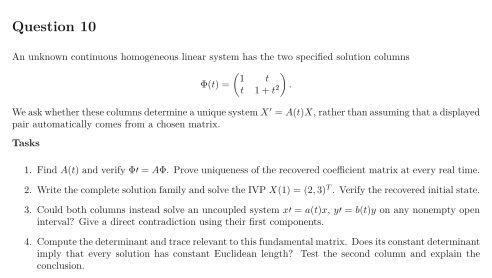
Strategy. An invertible matrix of solution columns determines its coefficient matrix through its derivative, while its determinant alone does not determine lengths.
Step 1: Recover and verify the matrix. The determinant of is , so Multiplication gives . Any coefficient matrix satisfying the column equations must equal , proving uniqueness at every real time.
Step 2: Select the constants for the IVP. The full solution is with constant . Indeed for any solution, proving completeness. At time , Thus , which equals at . Its derivative follows either directly or from the verified column identity.
Step 3: Rule out an uncoupled alternative. The first component of the first column is the constant . Its equation would force throughout the interval. The first component of the second column is , whose derivative is ; with its proposed equation would instead give derivative . This is impossible on any nonempty interval. The coupling is essential.
Step 4: Separate independence from length preservation. Here and , consistent with the constant determinant. But the second solution column has squared length which is not constant. A nonzero determinant ensures independence of the columns; even a constant determinant does not force individual solution lengths to stay fixed. The explicit column supplies a counterexample.