Question 6
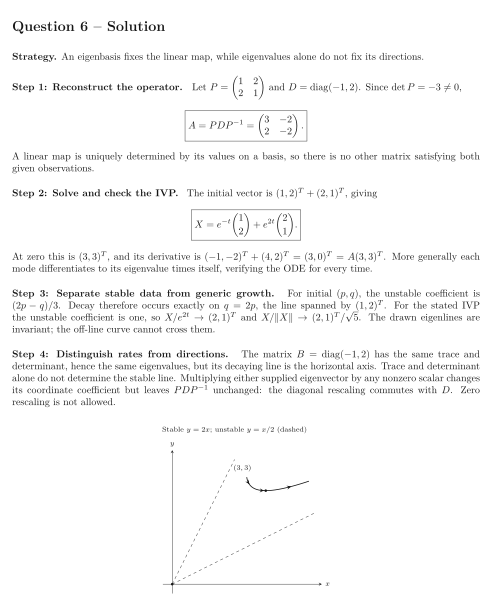
An unknown constant real matrix is known to satisfy These are exact eigenvector observations, not merely measured slopes.
Tasks
Reconstruct and justify its uniqueness.
Solve with . Verify the initial state and derivative directly.
Find the entire set of initial states that decay forward in time. Determine the limiting direction for the stated IVP.
Would knowing only and determine that decaying line? Give a concrete comparison matrix and explain the effect of rescaling either supplied eigenvector.
Show solutionHide solution
Question 6 – Solution
Strategy. An eigenbasis fixes the linear map, while eigenvalues alone do not fix its directions.
Step 1: Reconstruct the operator. Let and . Since , A linear map is uniquely determined by its values on a basis, so there is no other matrix satisfying both given observations.
Step 2: Solve and check the IVP. The initial vector is , giving At zero this is , and its derivative is . More generally each mode differentiates to its eigenvalue times itself, verifying the ODE for every time.
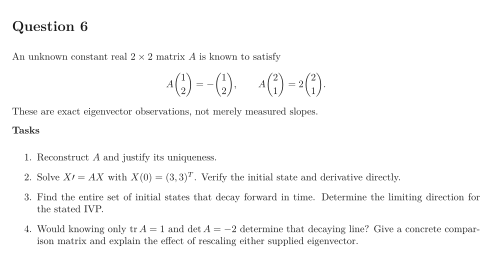
Step 3: Separate stable data from generic growth. For initial , the unstable coefficient is . Decay therefore occurs exactly on , the line spanned by . For the stated IVP the unstable coefficient is one, so and . The drawn eigenlines are invariant; the off-line curve cannot cross them.
Step 4: Distinguish rates from directions. The matrix has the same trace and determinant, hence the same eigenvalues, but its decaying line is the horizontal axis. Trace and determinant alone do not determine the stable line. Multiplying either supplied eigenvector by any nonzero scalar changes its coordinate coefficient but leaves unchanged: the diagonal rescaling commutes with . Zero rescaling is not allowed.
See the diagram in the original worksheet below.