Question 7
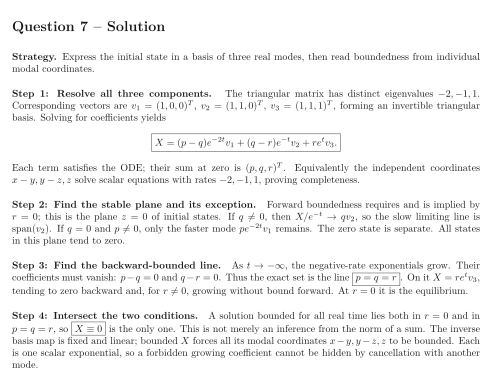
Consider the three-dimensional homogeneous system A solution is called bounded forward (backward) if its Euclidean norm is bounded on (respectively ).
Tasks
Find an eigenbasis and use it to write the complete solution for arbitrary .
Find exactly the initial states giving bounded forward solutions. Within that set, distinguish the slow and fast nonzero decay directions.
Find exactly the initial states giving bounded backward solutions, and describe their forward behavior.
Determine every solution bounded on the entire real line. Explain why cancellation between distinct growing modes cannot produce additional cases.
Show solutionHide solution
Question 7 – Solution
Strategy. Express the initial state in a basis of three real modes, then read boundedness from individual modal coordinates.
Step 1: Resolve all three components. The triangular matrix has distinct eigenvalues . Corresponding vectors are , , , forming an invertible triangular basis. Solving for coefficients yields Each term satisfies the ODE; their sum at zero is . Equivalently the independent coordinates solve scalar equations with rates , proving completeness.
Step 2: Find the stable plane and its exception. Forward boundedness requires and is implied by ; this is the plane of initial states. If , then , so the slow limiting line is . If and , only the faster mode remains. The zero state is separate. All states in this plane tend to zero.
Step 3: Find the backward-bounded line. As , the negative-rate exponentials grow. Their coefficients must vanish: and . Thus the exact set is the line . On it , tending to zero backward and, for , growing without bound forward. At it is the equilibrium.
Step 4: Intersect the two conditions. A solution bounded for all real time lies both in and in , so is the only one. This is not merely an inference from the norm of a sum. The inverse basis map is fixed and linear; bounded forces all its modal coordinates to be bounded. Each is one scalar exponential, so a forbidden growing coefficient cannot be hidden by cancellation with another mode.