Question 8
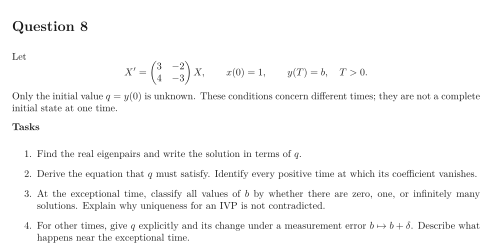
Let Only the initial value is unknown. These conditions concern different times; they are not a complete initial state at one time.
Tasks
Find the real eigenpairs and write the solution in terms of .
Derive the equation that must satisfy. Identify every positive time at which its coefficient vanishes.
At the exceptional time, classify all values of by whether there are zero, one, or infinitely many solutions. Explain why uniqueness for an IVP is not contradicted.
For other times, give explicitly and its change under a measurement error . Describe what happens near the exceptional time.
Show solutionHide solution
Question 8 – Solution
Strategy. Two real exponential modes can cancel in an endpoint observation even when the full state remains uniquely determined by its initial data.
Step 1: Find the two modes. The characteristic polynomial is . Eigenvectors are for and for . The data give coefficients and , so
Step 2: Locate the singular observation time. The endpoint condition becomes The coefficient of vanishes exactly when , hence , the unique positive exceptional time.
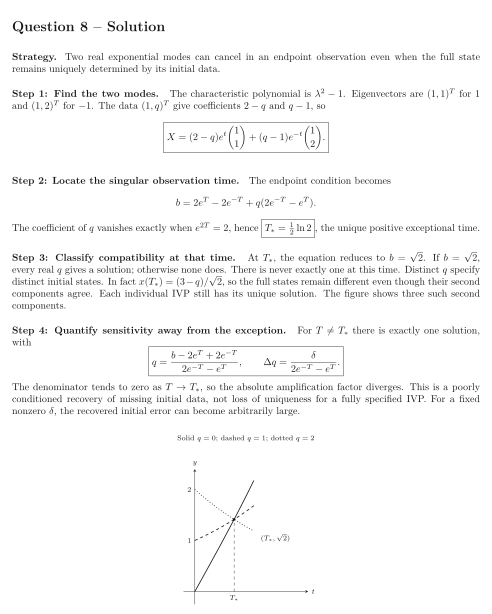
Step 3: Classify compatibility at that time. At , the equation reduces to . If , every real gives a solution; otherwise none does. There is never exactly one at this time. Distinct specify distinct initial states. In fact , so the full states remain different even though their second components agree. Each individual IVP still has its unique solution. The figure shows three such second components.
Step 4: Quantify sensitivity away from the exception. For there is exactly one solution, with The denominator tends to zero as , so the absolute amplification factor diverges. This is a poorly conditioned recovery of missing initial data, not loss of uniqueness for a fully specified IVP. For a fixed nonzero , the recovered initial error can become arbitrarily large.
See the diagram in the original worksheet below.