Question 3
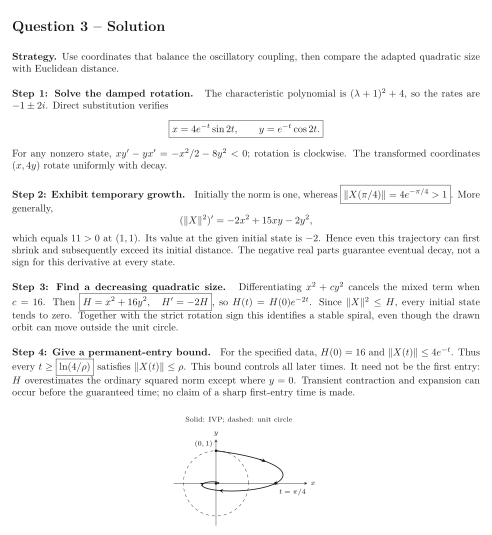
Let Use . A stable spiral means that all nearby states approach the origin with continuing rotation, not necessarily that their ordinary distance decreases at every instant.
Tasks
Find the eigenvalues and solve the IVP. Determine its rotation direction.
Evaluate the norm at and compare it with its initial value. Compute at a general state.
Find a positive quadratic expression with . Use it to establish decay of every solution.
For the given IVP and , give an explicit time after which the state is guaranteed to remain in . Explain why this guarantee need not be the first entry time.
Show solutionHide solution
Question 3 – Solution
Strategy. Use coordinates that balance the oscillatory coupling, then compare the adapted quadratic size with Euclidean distance.
Step 1: Solve the damped rotation. The characteristic polynomial is , so the rates are . Direct substitution verifies For any nonzero state, ; rotation is clockwise. The transformed coordinates rotate uniformly with decay.
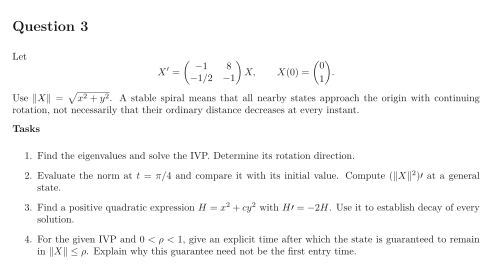
Step 2: Exhibit temporary growth. Initially the norm is one, whereas . More generally, which equals at . Its value at the given initial state is . Hence even this trajectory can first shrink and subsequently exceed its initial distance. The negative real parts guarantee eventual decay, not a sign for this derivative at every state.
Step 3: Find a decreasing quadratic size. Differentiating cancels the mixed term when . Then , so . Since , every initial state tends to zero. Together with the strict rotation sign this identifies a stable spiral, even though the drawn orbit can move outside the unit circle.
Step 4: Give a permanent-entry bound. For the specified data, and . Thus every satisfies . This bound controls all later times. It need not be the first entry: overestimates the ordinary squared norm except where . Transient contraction and expansion can occur before the guaranteed time; no claim of a sharp first-entry time is made.
See the diagram in the original worksheet below.