Question 7
A damped oscillator is written as a state system Here is displacement and is velocity. A turning point means a time when the displacement has a local maximum or minimum.
Tasks
Find the complex eigenvalues and the real IVP solution.
Find the first positive zero of the displacement and the velocity there, retaining its sign.
Find the first positive turning time and classify that turning point. Determine the ratio of the magnitudes of consecutive displacement extrema.
Compute the derivative of the mechanical energy . Explain why does not make the motion constant or periodic.
Show solutionHide solution
Question 7 – Solution
Strategy. The state components have different phases: displacement zeros and velocity zeros mark different events on the spiral.
Step 1: Solve the state IVP. The characteristic polynomial is , giving . The initial conditions yield Differentiation gives and , including .
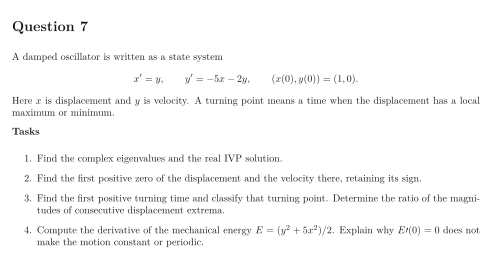
Step 2: Locate the first displacement crossing. Write . The first positive root of occurs at Indeed and . The negative velocity shows a crossing from positive to negative displacement, not a turning point.
Step 3: Separate the turning events. Velocity vanishes exactly at , for integers . The first positive turning time is , with displacement . There , so it is a minimum. Successive extrema have ; their absolute values have ratio for consecutive forward extrema. Successive positive maxima are one full oscillation apart and have ratio .
Step 4: Interpret dissipation at a zero derivative. The energy derivative is . At zero, so , but the acceleration is and the state immediately changes. On any nontrivial time interval this solution has somewhere, so its energy strictly drops over that interval. A nonconstant periodic solution would instead require zero total energy loss over a period, forcing and then , a contradiction. The phase arrows distinguish the crossing and turning points.
See the diagram in the original worksheet below.