Question 4
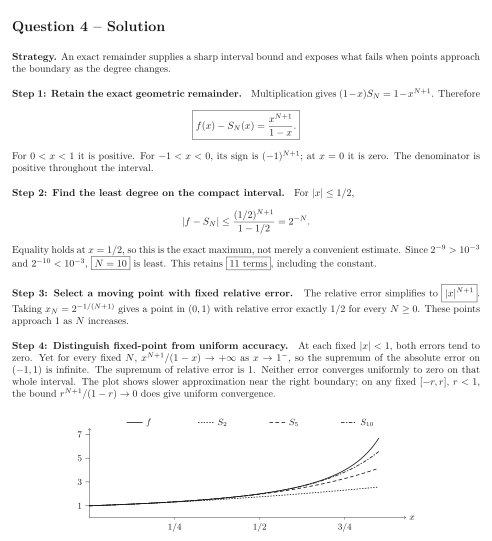
For an integer , define A student says that choosing a sufficiently large makes this approximation uniformly accurate throughout the entire convergence interval.
Tasks
Derive the exact remainder from a finite geometric identity. State its sign for positive and negative .
Find the least guaranteeing absolute error at most for every . State both the largest exponent and the number of retained terms.
Express the relative error . For any fixed , find a point in where this error is exactly .
Decide whether convergence is uniform on , for either absolute or relative error, and justify the distinction from convergence at each fixed point. Plot and on .
Show solutionHide solution
Question 4 – Solution
Strategy. An exact remainder supplies a sharp interval bound and exposes what fails when points approach the boundary as the degree changes.
Step 1: Retain the exact geometric remainder. Multiplication gives . Therefore For it is positive. For , its sign is ; at it is zero. The denominator is positive throughout the interval.
Step 2: Find the least degree on the compact interval. For , Equality holds at , so this is the exact maximum, not merely a convenient estimate. Since and , is least. This retains , including the constant.
Step 3: Select a moving point with fixed relative error. The relative error simplifies to . Taking gives a point in with relative error exactly for every . These points approach as increases.
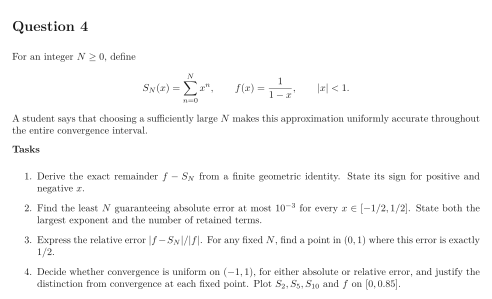
Step 4: Distinguish fixed-point from uniform accuracy. At each fixed , both errors tend to zero. Yet for every fixed , as , so the supremum of the absolute error on is infinite. The supremum of relative error is . Neither error converges uniformly to zero on that whole interval. The plot shows slower approximation near the right boundary; on any fixed , , the bound does give uniform convergence.
See the diagram in the original worksheet below.