Question 5
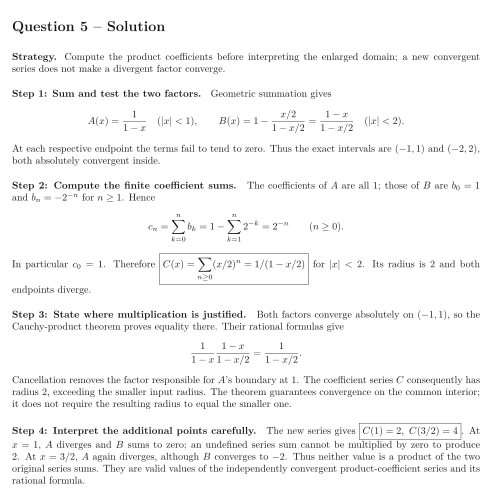
Consider two series centered at zero: Let be the series obtained by their Cauchy product, using finite coefficient convolutions.
Tasks
Find the sums and exact convergence intervals of and separately.
Compute for every , including the constant coefficient. Determine the radius and interval of the resulting series .
Identify the interval where the Cauchy-product theorem directly proves . Explain the rational cancellation that permits the new series to converge on a larger interval.
Evaluate the series at and . At each point, decide whether this value can legitimately be called the product of the two original series sums.
Show solutionHide solution
Question 5 – Solution
Strategy. Compute the product coefficients before interpreting the enlarged domain; a new convergent series does not make a divergent factor converge.
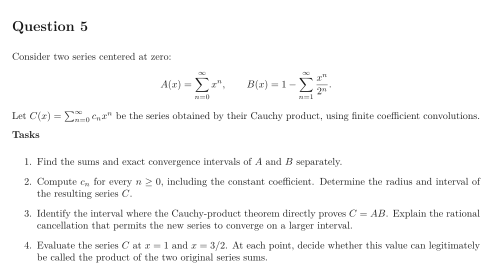
Step 1: Sum and test the two factors. Geometric summation gives At each respective endpoint the terms fail to tend to zero. Thus the exact intervals are and , both absolutely convergent inside.
Step 2: Compute the finite coefficient sums. The coefficients of are all ; those of are and for . Hence In particular . Therefore for . Its radius is and both endpoints diverge.
Step 3: State where multiplication is justified. Both factors converge absolutely on , so the Cauchy-product theorem proves equality there. Their rational formulas give Cancellation removes the factor responsible for ’s boundary at . The coefficient series consequently has radius , exceeding the smaller input radius. The theorem guarantees convergence on the common interior; it does not require the resulting radius to equal the smaller one.
Step 4: Interpret the additional points carefully. The new series gives . At , diverges and sums to zero; an undefined series sum cannot be multiplied by zero to produce . At , again diverges, although converges to . Thus neither value is a product of the two original series sums. They are valid values of the independently convergent product-coefficient series and its rational formula.