Question 8
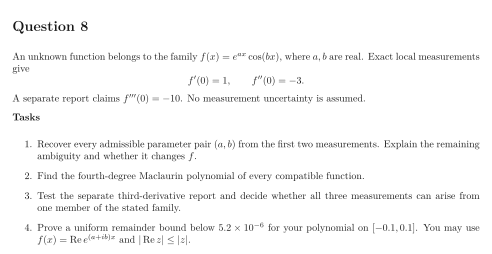
An unknown function belongs to the family , where are real. Exact local measurements give A separate report claims . No measurement uncertainty is assumed.
Tasks
Recover every admissible parameter pair from the first two measurements. Explain the remaining ambiguity and whether it changes .
Find the fourth-degree Maclaurin polynomial of every compatible function.
Test the separate third-derivative report and decide whether all three measurements can arise from one member of the stated family.
Prove a uniform remainder bound below for your polynomial on . You may use and .
Show solutionHide solution
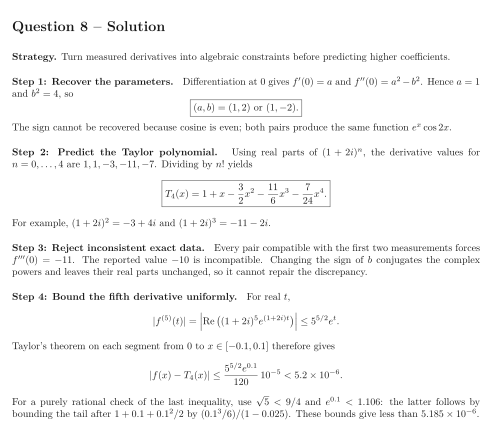
Question 8 – Solution
Strategy. Turn measured derivatives into algebraic constraints before predicting higher coefficients.
Step 1: Recover the parameters. Differentiation at gives and . Hence and , so The sign cannot be recovered because cosine is even; both pairs produce the same function .
Step 2: Predict the Taylor polynomial. Using real parts of , the derivative values for are . Dividing by yields For example, and .
Step 3: Reject inconsistent exact data. Every pair compatible with the first two measurements forces . The reported value is incompatible. Changing the sign of conjugates the complex powers and leaves their real parts unchanged, so it cannot repair the discrepancy.
Step 4: Bound the fifth derivative uniformly. For real , Taylor’s theorem on each segment from to therefore gives For a purely rational check of the last inequality, use and : the latter follows by bounding the tail after by . These bounds give less than .