Question 9
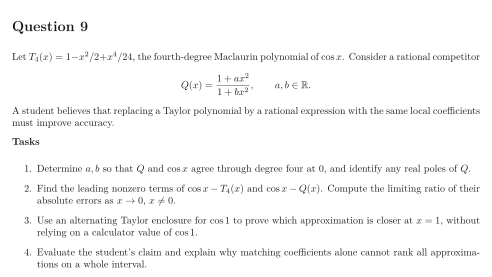
Let , the fourth-degree Maclaurin polynomial of . Consider a rational competitor A student believes that replacing a Taylor polynomial by a rational expression with the same local coefficients must improve accuracy.
Tasks
Determine so that and agree through degree four at , and identify any real poles of .
Find the leading nonzero terms of and . Compute the limiting ratio of their absolute errors as , .
Use an alternating Taylor enclosure for to prove which approximation is closer at , without relying on a calculator value of .
Evaluate the student’s claim and explain why matching coefficients alone cannot rank all approximations on a whole interval.
Show solutionHide solution
Question 9 – Solution
Strategy. Match coefficients, then examine the first coefficient on which the competing approximations disagree.
Step 1: Solve the matching equations. Near , . Thus and , giving Since , there are no real poles.
Step 2: Compare the leading errors. The rational geometric expansion has coefficient . Hence Therefore . In particular, the rational approximation is worse for all sufficiently small nonzero .
Step 3: Make an exact comparison at one. Alternating bounds give Here , and the midpoint of the two approximations is . Thus lies above their midpoint and between them: is strictly closer than .
Step 4: State the proper conclusion. The claim fails both locally and at . Matching four derivatives fixes contact at the center, not the next error coefficient or behavior far away. For , alternating bounds give and since . These signs explain the plotted errors.
See the diagram in the original worksheet below.
