Question 3
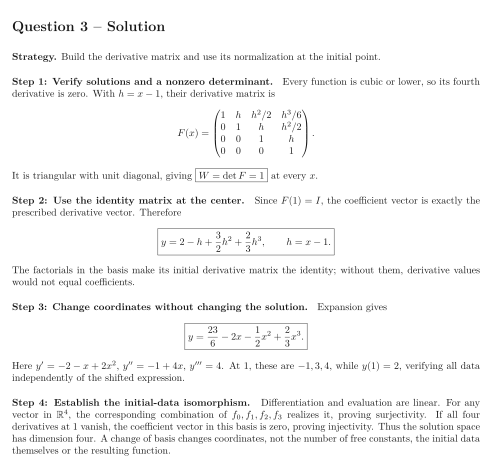
For on , consider the shifted functions Initial derivatives and polynomial coefficients coincide only for an appropriately normalized basis.
Tasks
Verify that the four functions solve the equation and compute their Wronskian for arbitrary .
Construct the solution with , , and . Explain why the coefficients in this basis can be read directly from the data.
Express the same solution in the unshifted basis and verify the four data in that form.
Prove that the map sending a solution to is a linear isomorphism onto . What does this say about the number of free constants and the effect of changing the basis?
Show solutionHide solution
Question 3 – Solution
Strategy. Build the derivative matrix and use its normalization at the initial point.
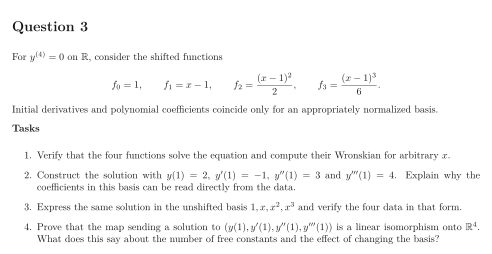
Step 1: Verify solutions and a nonzero determinant. Every function is cubic or lower, so its fourth derivative is zero. With , their derivative matrix is It is triangular with unit diagonal, giving at every .
Step 2: Use the identity matrix at the center. Since , the coefficient vector is exactly the prescribed derivative vector. Therefore The factorials in the basis make its initial derivative matrix the identity; without them, derivative values would not equal coefficients.
Step 3: Change coordinates without changing the solution. Expansion gives Here , , . At , these are , while , verifying all data independently of the shifted expression.
Step 4: Establish the initial-data isomorphism. Differentiation and evaluation are linear. For any vector in , the corresponding combination of realizes it, proving surjectivity. If all four derivatives at vanish, the coefficient vector in this basis is zero, proving injectivity. Thus the solution space has dimension four. A change of basis changes coordinates, not the number of free constants, the initial data themselves or the resulting function.