Question 4
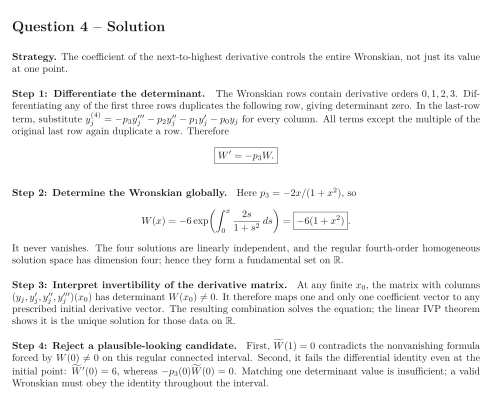
Four functions solve the same homogeneous equation on , where are continuous. Their Wronskian at zero is .
Tasks
Derive the Wronskian identity for a normalized fourth-order homogeneous equation, by differentiating the determinant row by row.
Determine for the stated equation and decide whether the four functions form a fundamental set on the whole real line.
Explain why every four-component initial derivative vector at any finite is realized by exactly one linear combination of these functions.
A computation reports . It has the correct value at . Give two independent reasons why it cannot be the Wronskian of this common solution family.
Show solutionHide solution
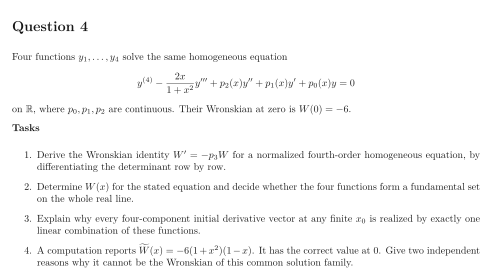
Question 4 – Solution
Strategy. The coefficient of the next-to-highest derivative controls the entire Wronskian, not just its value at one point.
Step 1: Differentiate the determinant. The Wronskian rows contain derivative orders . Differentiating any of the first three rows duplicates the following row, giving determinant zero. In the last-row term, substitute for every column. All terms except the multiple of the original last row again duplicate a row. Therefore
Step 2: Determine the Wronskian globally. Here , so It never vanishes. The four solutions are linearly independent, and the regular fourth-order homogeneous solution space has dimension four; hence they form a fundamental set on .
Step 3: Interpret invertibility of the derivative matrix. At any finite , the matrix with columns has determinant . It therefore maps one and only one coefficient vector to any prescribed initial derivative vector. The resulting combination solves the equation; the linear IVP theorem shows it is the unique solution for those data on .
Step 4: Reject a plausible-looking candidate. First, contradicts the nonvanishing formula forced by on this regular connected interval. Second, it fails the differential identity even at the initial point: , whereas . Matching one determinant value is insufficient; a valid Wronskian must obey the identity throughout the interval.