Question 9
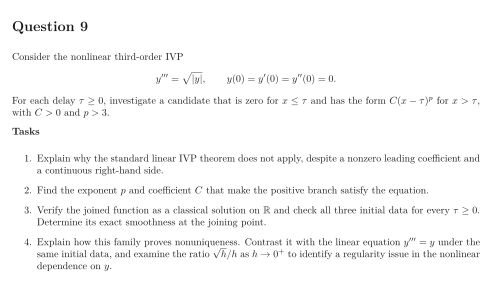
Consider the nonlinear third-order IVP For each delay , investigate a candidate that is zero for and has the form for , with and .
Tasks
Explain why the standard linear IVP theorem does not apply, despite a nonzero leading coefficient and a continuous right-hand side.
Find the exponent and coefficient that make the positive branch satisfy the equation.
Verify the joined function as a classical solution on and check all three initial data for every . Determine its exact smoothness at the joining point.
Explain how this family proves nonuniqueness. Contrast it with the linear equation under the same initial data, and examine the ratio as to identify a regularity issue in the nonlinear dependence on .
Show solutionHide solution
Question 9 – Solution
Strategy. Construct actual delayed solutions; continuity of a nonlinear right-hand side alone is not a uniqueness proof.
Step 1: Check linearity, not just the leading coefficient. The equation is third order but nonlinear because is not a linear function of the unknown. A leading coefficient of and continuity do not make the linear existence-and-uniqueness theorem applicable.
Step 2: Balance exponents and amplitudes. For , the proposed branch has and . Since and , equality requires , giving . Then , so .
Step 3: Verify the join and the initial state. Define Derivatives through order five approach zero from the right and equal zero on the left; difference quotients at the join give the same derivatives. Thus , and the equation holds at the join too, since there. The sixth derivative jumps from to , so it is not at . Because , all three initial data vanish, including when .
Step 4: Identify the precise contrast. Distinct delays give distinct solutions with identical initial data; the identically zero function is another solution. This proves nonuniqueness constructively. For the linear equation , continuous normalized coefficients and the same zero initial vector force the unique zero solution. Here , so the nonlinear right-hand side is not locally Lipschitz in at zero. Nonlinearity alone does not always cause nonuniqueness; the displayed family establishes the failure in this specific case.
See the diagram in the original worksheet below.
