Question 10
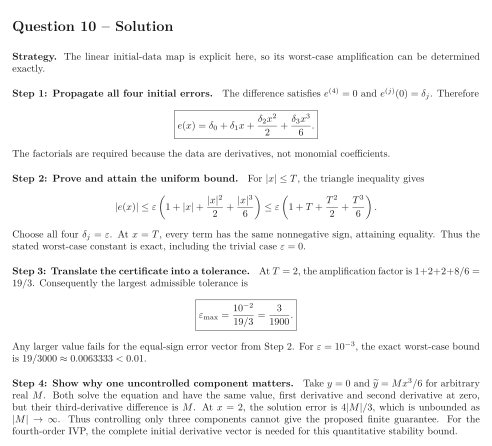
Two solutions of on have initial derivative errors where . Let . We want a guaranteed error bound over a whole interval, not just at the initial point.
Tasks
Find exactly in terms of the four initial errors.
For , prove the sharp uniform bound Show that the constant cannot be improved when only the stated error information is available.
At , find the largest guaranteeing solution error at most for every admissible initial error vector. Evaluate the guarantee for .
If only are controlled, can any finite uniform guarantee depending on those three errors alone hold on ? Construct a decisive example and interpret what the result says about a complete initial state.
Show solutionHide solution
Question 10 – Solution
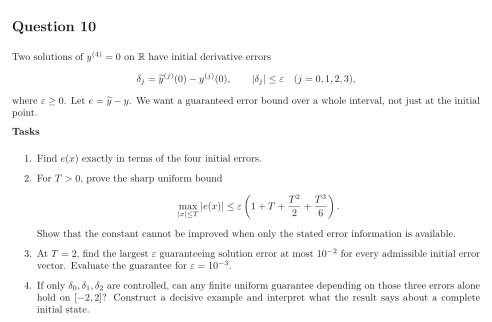
Strategy. The linear initial-data map is explicit here, so its worst-case amplification can be determined exactly.
Step 1: Propagate all four initial errors. The difference satisfies and . Therefore The factorials are required because the data are derivatives, not monomial coefficients.
Step 2: Prove and attain the uniform bound. For , the triangle inequality gives Choose all four . At , every term has the same nonnegative sign, attaining equality. Thus the stated worst-case constant is exact, including the trivial case .
Step 3: Translate the certificate into a tolerance. At , the amplification factor is . Consequently the largest admissible tolerance is Any larger value fails for the equal-sign error vector from Step 2. For , the exact worst-case bound is .
Step 4: Show why one uncontrolled component matters. Take and for arbitrary real . Both solve the equation and have the same value, first derivative and second derivative at zero, but their third-derivative difference is . At , the solution error is , which is unbounded as . Thus controlling only three components cannot give the proposed finite guarantee. For the fourth-order IVP, the complete initial derivative vector is needed for this quantitative stability bound.