Question 3
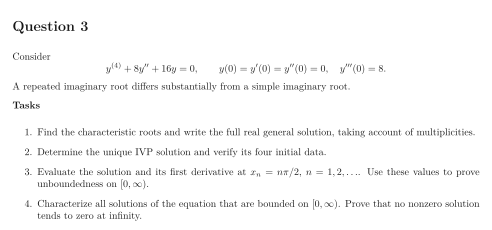
Consider A repeated imaginary root differs substantially from a simple imaginary root.
Tasks
Find the characteristic roots and write the full real general solution, taking account of multiplicities.
Determine the unique IVP solution and verify its four initial data.
Evaluate the solution and its first derivative at , . Use these values to prove unboundedness on .
Characterize all solutions of the equation that are bounded on . Prove that no nonzero solution tends to zero at infinity.
Show solutionHide solution
Question 3 – Solution
Strategy. Retain the polynomial factors attached to repeated conjugate roots and test growth at suitable phases.
Step 1: Build the real basis. The polynomial is , with roots , each twice. Thus Omitting the factors and would lose half the solution space.
Step 2: Fit the initial vector. At zero the four derivatives are The data give , and , hence Indeed , , and , verifying all four data. Each basis term satisfies the factored equation.
Step 3: Exhibit growing extrema. For , we have These are alternating strict extrema with unbounded magnitude. In particular, purely imaginary roots alone do not imply boundedness when they are repeated.
Step 4: Classify the bounded family. If , choose a sequence on which . The linear-in- part grows, whereas is bounded. Therefore boundedness is equivalent to , a two-dimensional subspace. A nonzero member of that subspace attains its positive amplitude infinitely often, so it cannot tend to zero. An unbounded member cannot tend to zero either.
See the diagram in the original worksheet below.
