Question 4
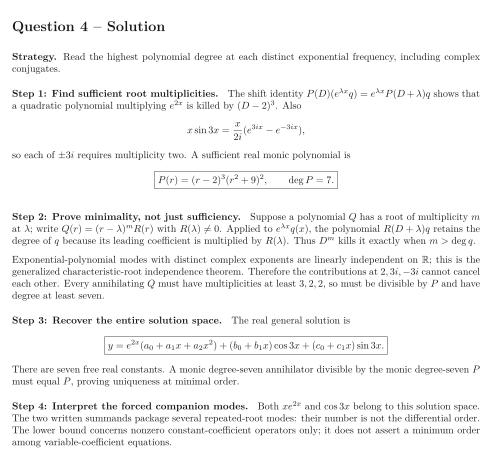
An observed signal is known exactly on : Seek a real, monic, constant-coefficient homogeneous differential equation of the smallest possible order having this signal as a solution. Here monic means that the coefficient of the highest derivative is .
Tasks
Find a factored characteristic polynomial that annihilates , carefully determining the multiplicity of every root.
Prove that no nonzero constant-coefficient differential operator of smaller order can annihilate . State which independence fact prevents cancellation between its different exponential modes.
Write the complete real general solution of the resulting minimal equation and explain why its monic characteristic polynomial is unique.
Must this same equation also admit and as solutions? Explain why the two displayed summands of do not mean that a second-order equation suffices. Restrict the conclusion to constant coefficients.
Show solutionHide solution
Question 4 – Solution
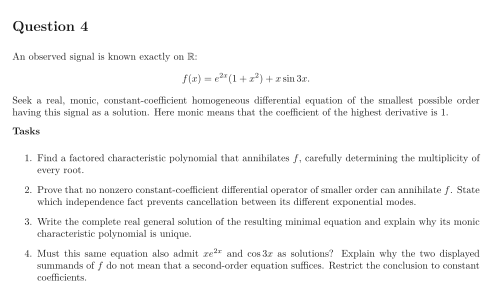
Strategy. Read the highest polynomial degree at each distinct exponential frequency, including complex conjugates.
Step 1: Find sufficient root multiplicities. The shift identity shows that a quadratic polynomial multiplying is killed by . Also so each of requires multiplicity two. A sufficient real monic polynomial is
Step 2: Prove minimality, not just sufficiency. Suppose a polynomial has a root of multiplicity at ; write with . Applied to , the polynomial retains the degree of because its leading coefficient is multiplied by . Thus kills it exactly when .
Exponential-polynomial modes with distinct complex exponents are linearly independent on ; this is the generalized characteristic-root independence theorem. Therefore the contributions at cannot cancel each other. Every annihilating must have multiplicities at least , so must be divisible by and have degree at least seven.
Step 3: Recover the entire solution space. The real general solution is There are seven free real constants. A monic degree-seven annihilator divisible by the monic degree-seven must equal , proving uniqueness at minimal order.
Step 4: Interpret the forced companion modes. Both and belong to this solution space. The two written summands package several repeated-root modes: their number is not the differential order. The lower bound concerns nonzero constant-coefficient operators only; it does not assert a minimum order among variable-coefficient equations.