Question 5
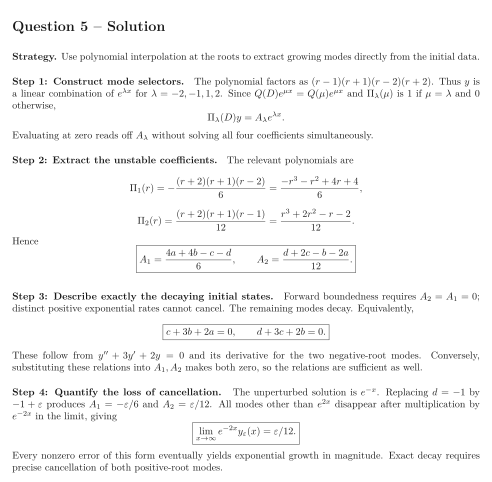
For the fourth-order equation write the initial derivatives as . For each simple characteristic root , define the polynomial where the product runs over the other characteristic roots.
Tasks
Find the roots and prove that isolates the single mode in the general solution.
Compute the coefficients of and explicitly from using these polynomials.
Give necessary and sufficient conditions on the initial derivatives for boundedness on . Express them also as two relations obtained from .
Start from and perturb only by a nonzero amount . Find the limit Explain the long-term consequence of arbitrarily small such errors.
Show solutionHide solution
Question 5 – Solution
Strategy. Use polynomial interpolation at the roots to extract growing modes directly from the initial data.
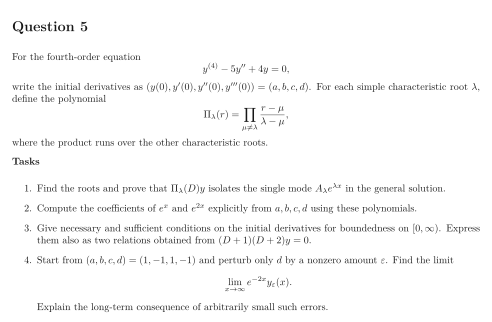
Step 1: Construct mode selectors. The polynomial factors as . Thus is a linear combination of for . Since and is if and otherwise, Evaluating at zero reads off without solving all four coefficients simultaneously.
Step 2: Extract the unstable coefficients. The relevant polynomials are Hence
Step 3: Describe exactly the decaying initial states. Forward boundedness requires ; distinct positive exponential rates cannot cancel. The remaining modes decay. Equivalently, These follow from and its derivative for the two negative-root modes. Conversely, substituting these relations into makes both zero, so the relations are sufficient as well.
Step 4: Quantify the loss of cancellation. The unperturbed solution is . Replacing by produces and . All modes other than disappear after multiplication by in the limit, giving Every nonzero error of this form eventually yields exponential growth in magnitude. Exact decay requires precise cancellation of both positive-root modes.