Question 1
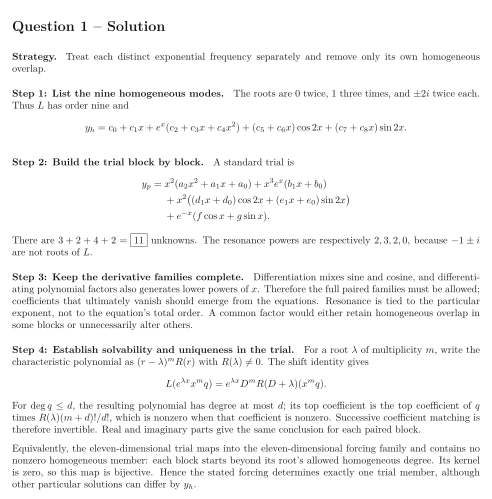
Write and let Consider on the equation This question concerns designing and justifying the coefficient trial, not carrying out a large elimination.
Tasks
State the order and complete real homogeneous solution, with all root multiplicities.
Write the standard undetermined-coefficient trial for a particular solution, including all polynomial degrees, both trigonometric partners, and every resonance factor. Count its unknown coefficients.
Explain why a trial containing only cosine terms for , or only sine terms for , is not the appropriate full trial. Explain why one common resonance factor for all four forcing terms is inappropriate.
Prove that substitution determines exactly one member of your trial space. Use the effect of on each polynomial-exponential family and its intersection with the homogeneous solution space. You need not compute the eleven coefficients.
Show solutionHide solution
Question 1 – Solution
Strategy. Treat each distinct exponential frequency separately and remove only its own homogeneous overlap.
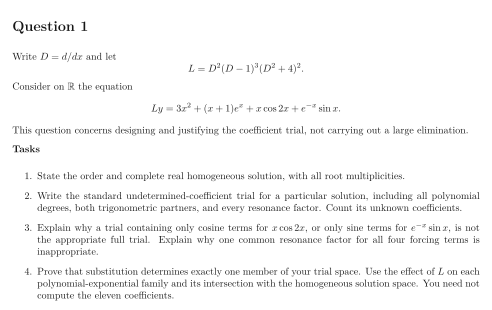
Step 1: List the nine homogeneous modes. The roots are twice, three times, and twice each. Thus has order nine and
Step 2: Build the trial block by block. A standard trial is There are unknowns. The resonance powers are respectively , because are not roots of .
Step 3: Keep the derivative families complete. Differentiation mixes sine and cosine, and differentiating polynomial factors also generates lower powers of . Therefore the full paired families must be allowed; coefficients that ultimately vanish should emerge from the equations. Resonance is tied to the particular exponent, not to the equation’s total order. A common factor would either retain homogeneous overlap in some blocks or unnecessarily alter others.
Step 4: Establish solvability and uniqueness in the trial. For a root of multiplicity , write the characteristic polynomial as with . The shift identity gives For , the resulting polynomial has degree at most ; its top coefficient is the top coefficient of times , which is nonzero when that coefficient is nonzero. Successive coefficient matching is therefore invertible. Real and imaginary parts give the same conclusion for each paired block.
Equivalently, the eleven-dimensional trial maps into the eleven-dimensional forcing family and contains no nonzero homogeneous member: each block starts beyond its root’s allowed homogeneous degree. Its kernel is zero, so this map is bijective. Hence the stated forcing determines exactly one trial member, although other particular solutions can differ by .