Question 5
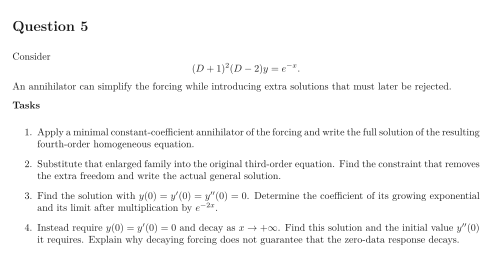
Consider An annihilator can simplify the forcing while introducing extra solutions that must later be rejected.
Tasks
Apply a minimal constant-coefficient annihilator of the forcing and write the full solution of the resulting fourth-order homogeneous equation.
Substitute that enlarged family into the original third-order equation. Find the constraint that removes the extra freedom and write the actual general solution.
Find the solution with . Determine the coefficient of its growing exponential and its limit after multiplication by .
Instead require and decay as . Find this solution and the initial value it requires. Explain why decaying forcing does not guarantee that the zero-data response decays.
Show solutionHide solution
Question 5 – Solution
Strategy. Retain the original equation as a constraint after annihilating its right-hand side.
Step 1: Solve the enlarged equation. The forcing is annihilated by . Applying it gives , whose general solution is This family has four constants, although the original equation has order three.
Step 2: Restore the original forcing. Under , the original operator becomes . For its value is ; the term is homogeneous. Thus , leaving Annihilation alone only ensures that the original residual is a multiple of , not that its coefficient equals one.
Step 3: Fit the zero initial vector. The three equations are , , and . They yield , , , so The displayed coefficient equations verify the initial data, and Step 2 verifies the forcing.
Step 4: Replace curvature data by a future condition. Decay requires ; with , this gives . Hence This is the unique decaying response with those first two data. The zero-data response must add a growing homogeneous mode to cancel the particular solution’s initial curvature. Decay of the input alone does not suppress that mode.
See the diagram in the original worksheet below.
