Question 6
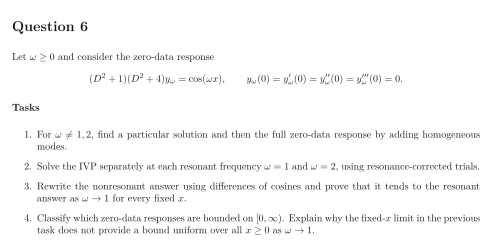
Let and consider the zero-data response
Tasks
For , find a particular solution and then the full zero-data response by adding homogeneous modes.
Solve the IVP separately at each resonant frequency and , using resonance-corrected trials.
Rewrite the nonresonant answer using differences of cosines and prove that it tends to the resonant answer as for every fixed .
Classify which zero-data responses are bounded on . Explain why the fixed- limit in the previous task does not provide a bound uniform over all as .
Show solutionHide solution
Question 6 – Solution
Strategy. Enforce the initial data before taking a resonant limit; separate divergent terms can cancel.
Step 1: Solve away from resonance. Set . The trial has the required residual. Odd initial derivatives vanish; adding and matching the value and second derivative gives Indeed and , which verify the remaining two data.
Step 2: Solve at the two simple resonances. For , direct differentiation gives and . Adding homogeneous cosine terms to enforce zero value and curvature yields Both are even and vanish at zero. Their second derivatives at zero vanish by cancellation of with in each case, so all four initial data hold.
Step 3: Take the limit of the combined response. Partial fractions give For fixed , the first ratio tends to by differentiating numerator and denominator with respect to . The second tends to . The resulting limit is exactly .
Step 4: Distinguish the two limit questions. Every fixed nonresonant response is a bounded sum of cosines. At resonance, the linear sine term has unbounded values along its phase maxima, and the added cosines remain bounded. Thus boundedness holds exactly when . A common bound for all and all nonresonant sufficiently near would pass to the fixed- limit and bound everywhere, a contradiction.
See the diagram in the original worksheet below.
