Question 9
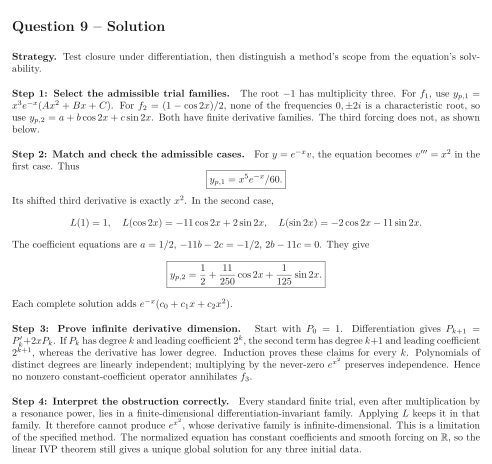
For the operator , consider three separate forcing functions The standard finite undetermined-coefficient method uses polynomial-exponential-trigonometric families closed under differentiation, with resonance corrections when required.
Tasks
Decide which forcings admit this standard finite method. Give complete real trials for each admissible forcing, first simplifying trigonometric products.
Compute and verify one particular solution for each admissible forcing. State the common homogeneous family to be added in both cases.
Prove that the derivatives of span an infinite-dimensional space: write and determine the degree and leading coefficient of .
Explain why this rules out the standard finite trial method for , while not ruling out existence or uniqueness of the IVP with any prescribed . Do not use variation of parameters to solve it here.
Show solutionHide solution
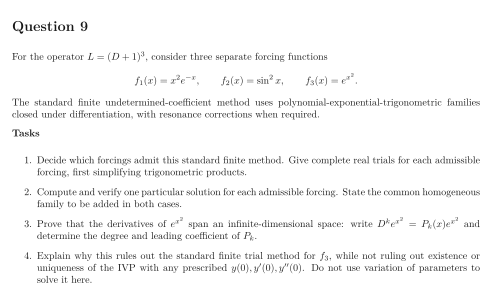
Question 9 – Solution
Strategy. Test closure under differentiation, then distinguish a method’s scope from the equation’s solvability.
Step 1: Select the admissible trial families. The root has multiplicity three. For , use . For , none of the frequencies is a characteristic root, so use . Both have finite derivative families. The third forcing does not, as shown below.
Step 2: Match and check the admissible cases. For , the equation becomes in the first case. Thus Its shifted third derivative is exactly . In the second case, The coefficient equations are , , . They give Each complete solution adds .
Step 3: Prove infinite derivative dimension. Start with . Differentiation gives . If has degree and leading coefficient , the second term has degree and leading coefficient , whereas the derivative has lower degree. Induction proves these claims for every . Polynomials of distinct degrees are linearly independent; multiplying by the never-zero preserves independence. Hence no nonzero constant-coefficient operator annihilates .
Step 4: Interpret the obstruction correctly. Every standard finite trial, even after multiplication by a resonance power, lies in a finite-dimensional differentiation-invariant family. Applying keeps it in that family. It therefore cannot produce , whose derivative family is infinite-dimensional. This is a limitation of the specified method. The normalized equation has constant coefficients and smooth forcing on , so the linear IVP theorem still gives a unique global solution for any three initial data.