Question 1
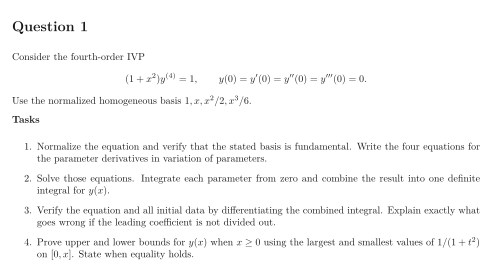
Consider the fourth-order IVP Use the normalized homogeneous basis .
Tasks
Normalize the equation and verify that the stated basis is fundamental. Write the four equations for the parameter derivatives in variation of parameters.
Solve those equations. Integrate each parameter from zero and combine the result into one definite integral for .
Verify the equation and all initial data by differentiating the combined integral. Explain exactly what goes wrong if the leading coefficient is not divided out.
Prove upper and lower bounds for when using the largest and smallest values of on . State when equality holds.
Show solutionHide solution
Question 1 – Solution
Strategy. Normalize first, then combine the four parameter integrals into one positive kernel.
Step 1: Form the normalized parameter system. Put . The derivative matrix of the given basis is triangular with unit diagonal, so its Wronskian is . The parameter derivatives satisfy The first three zero rows remove derivative terms introduced by varying the constants; the last row supplies the normalized forcing.
Step 2: Solve and combine. Back substitution gives . Choose each . In , the combined numerator is , yielding Oriented integration also defines the solution for negative .
Step 3: Verify the initial state and residual. Successive derivatives have kernels , , and , all divided by . The fourth derivative is . The first four state components vanish at zero, and multiplication by gives the original forcing. If one incorrectly uses , the same construction gives , whose original residual is , not .
Step 4: Bound the positive integral. For , . Hence Both inequalities are strict for , since their integrands differ on an interval of positive length where . Both become equalities at . The figure labels the lower and upper bounds and , respectively.
See the diagram in the original worksheet below.
