Variation of Parameters — Question 2

PDF ↗

Question 2

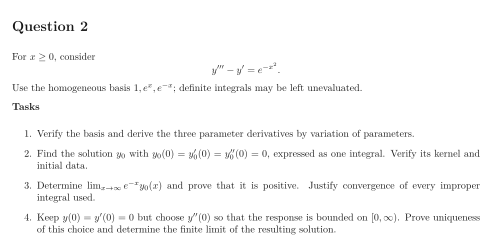
For x≥0x\ge 0, consider y‴−y′=e−x2.y'''-y'=e^{-x^2}. Use the homogeneous basis 1,ex,e−x1,e^x,e^{-x}; definite integrals may be left unevaluated.

Tasks

  1. Verify the basis and derive the three parameter derivatives by variation of parameters.

  2. Find the solution y0y_0 with y0(0)=y0′(0)=y0″(0)=0y_0(0)=y_0'(0)=y_0''(0)=0, expressed as one integral. Verify its kernel and initial data.

  3. Determine lim⁡x→∞e−xy0(x)\lim_{x\to\infty}e^{-x}y_0(x) and prove that it is positive. Justify convergence of every improper integral used.

  4. Keep y(0)=y′(0)=0y(0)=y'(0)=0 but choose y″(0)y''(0) so that the response is bounded on [0,∞)[0,\infty). Prove uniqueness of this choice and determine the finite limit of the resulting solution.
Original worksheet page 1: question and worked solution for 7-4-002
Show solutionHide solution

Question 2 – Solution

Strategy. Use parameter integrals to isolate the growing homogeneous mode and the initial curvature needed to cancel it.

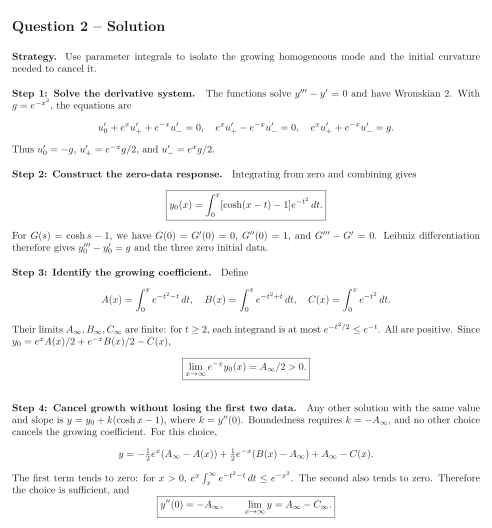
Step 1: Solve the derivative system. The functions solve y‴−y′=0y'''-y'=0 and have Wronskian 22. With g=e−x2g=e^{-x^2}, the equations are u0′+exu+′+e−xu−′=0,exu+′−e−xu−′=0,exu+′+e−xu−′=g.u_0'+e^xu_+'+e^{-x}u_-'=0,\quad e^xu_+'-e^{-x}u_-'=0,\quad e^xu_+'+e^{-x}u_-'=g. Thus u0′=−gu_0'=-g, u+′=e−xg/2u_+'=e^{-x}g/2, and u−′=exg/2u_-'=e^xg/2.

Step 2: Construct the zero-data response. Integrating from zero and combining gives y0(x)=∫0x[cosh⁡(x−t)−1]e−t2dt.\boxed{y_0(x)=\int_0^x[\cosh(x-t)-1]e^{-t^2}\,dt.} For G(s)=cosh⁡s−1G(s)=\cosh s-1, we have G(0)=G′(0)=0G(0)=G'(0)=0, G″(0)=1G''(0)=1, and G‴−G′=0G'''-G'=0. Leibniz differentiation therefore gives y0‴−y0′=gy_0'''-y_0'=g and the three zero initial data.

Step 3: Identify the growing coefficient. Define A(x)=∫0xe−t2−tdt,B(x)=∫0xe−t2+tdt,C(x)=∫0xe−t2dt.A(x)=\int_0^xe^{-t^2-t}\,dt,\quad B(x)=\int_0^xe^{-t^2+t}\,dt,\quad C(x)=\int_0^xe^{-t^2}\,dt. Their limits A∞,B∞,C∞A_\infty,B_\infty,C_\infty are finite: for t≥2t\ge 2, each integrand is at most e−t2/2≤e−te^{-t^2/2}\le e^{-t}. All are positive. Since y0=exA(x)/2+e−xB(x)/2−C(x)y_0=e^xA(x)/2+e^{-x}B(x)/2-C(x), limx→∞e−xy0(x)=A∞/2>0.\boxed{\lim_{x\to\infty}e^{-x}y_0(x)=A_\infty/2>0.}

Step 4: Cancel growth without losing the first two data. Any other solution with the same value and slope is y=y0+k(cosh⁡x−1)y=y_0+k(\cosh x-1), where k=y″(0)k=y''(0). Boundedness requires k=−A∞k=-A_\infty, and no other choice cancels the growing coefficient. For this choice, y=−12ex(A∞−A(x))+12e−x(B(x)−A∞)+A∞−C(x).y=-\tfrac 12e^x(A_\infty-A(x)) +\tfrac 12e^{-x}(B(x)-A_\infty)+A_\infty-C(x). The first term tends to zero: for x>0x>0, ex∫x∞e−t2−tdt≤e−x2e^x\int_x^\infty e^{-t^2-t}\,dt\le e^{-x^2}. The second also tends to zero. Therefore the choice is sufficient, and y″(0)=−A∞,limx→∞y=A∞−C∞.\boxed{y''(0)=-A_\infty,\qquad \lim_{x\to\infty}y=A_\infty-C_\infty.}
Original worksheet page 2: question and worked solution for 7-4-002

Original worksheet layout. Use Enlarge or open the PDF for a closer view.