Question 4
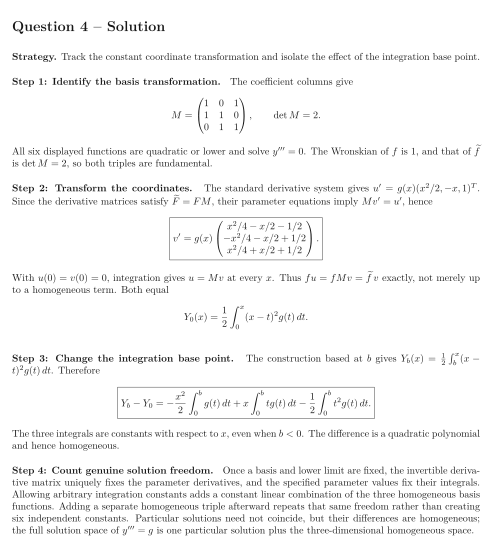
Let be continuous on and consider . Two homogeneous bases are Regard these as row vectors of functions and write , with column vectors of parameters.
Tasks
Find the constant matrix such that . Verify that both bases are fundamental.
Derive by variation of parameters, then obtain from the change of basis. Explain why the lower-limit-zero constructions produce exactly the same particular solution.
Replace the lower integration limit by an arbitrary real . Find the difference between the two resulting particular solutions and prove that it is homogeneous.
Explain why changing basis or choosing separate integration constants does not create more than three free constants in the general solution. Distinguish unique parameter coordinates in a chosen basis from the nonuniqueness of a particular solution.
Show solutionHide solution
Question 4 – Solution
Strategy. Track the constant coordinate transformation and isolate the effect of the integration base point.
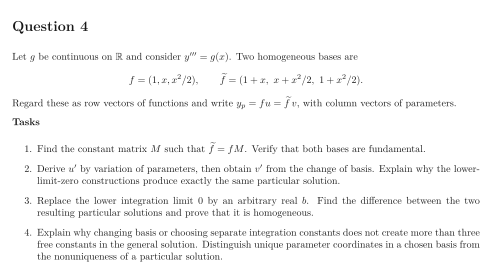
Step 1: Identify the basis transformation. The coefficient columns give All six displayed functions are quadratic or lower and solve . The Wronskian of is , and that of is , so both triples are fundamental.
Step 2: Transform the coordinates. The standard derivative system gives . Since the derivative matrices satisfy , their parameter equations imply , hence With , integration gives at every . Thus exactly, not merely up to a homogeneous term. Both equal
Step 3: Change the integration base point. The construction based at gives . Therefore The three integrals are constants with respect to , even when . The difference is a quadratic polynomial and hence homogeneous.
Step 4: Count genuine solution freedom. Once a basis and lower limit are fixed, the invertible derivative matrix uniquely fixes the parameter derivatives, and the specified parameter values fix their integrals. Allowing arbitrary integration constants adds a constant linear combination of the three homogeneous basis functions. Adding a separate homogeneous triple afterward repeats that same freedom rather than creating six independent constants. Particular solutions need not coincide, but their differences are homogeneous; the full solution space of is one particular solution plus the three-dimensional homogeneous space.