Question 5
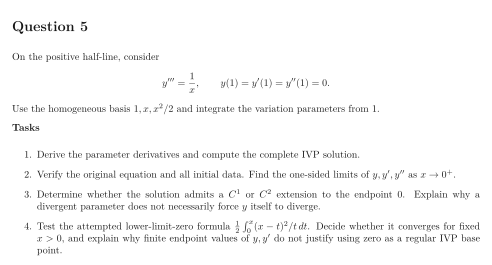
On the positive half-line, consider Use the homogeneous basis and integrate the variation parameters from .
Tasks
Derive the parameter derivatives and compute the complete IVP solution.
Verify the original equation and all initial data. Find the one-sided limits of as .
Determine whether the solution admits a or extension to the endpoint . Explain why a divergent parameter does not necessarily force itself to diverge.
Test the attempted lower-limit-zero formula . Decide whether it converges for fixed , and explain why finite endpoint values of do not justify using zero as a regular IVP base point.
Show solutionHide solution
Question 5 – Solution
Strategy. Separate parameter divergence, solution limits and the regularity needed for initial data.
Step 1: Integrate from the regular point. The triangular parameter system for gives . Here , so Combining yields
Step 2: Check derivatives and endpoint behavior. Direct differentiation gives These formulas and verify all three data at . Since and tend to zero at the positive endpoint,
Step 3: Classify the extension. Defining gives right derivative , because . This derivative is continuous from the right, so the solution extends as a function to ; it may also be continued to the left with matching value and slope. No extension is possible because diverges. Although diverges, it is multiplied by in , whose contribution tends to zero.
Step 4: Reject the singular base point. For fixed and , . The proposed improper integral therefore diverges to . Its lower limit cannot simply be moved to zero. The equation is singular there, and even the solution’s second derivative lacks finite initial data. Two finite endpoint limits do not supply a regular third-order initial state.
See the diagram in the original worksheet below.
