Question 10
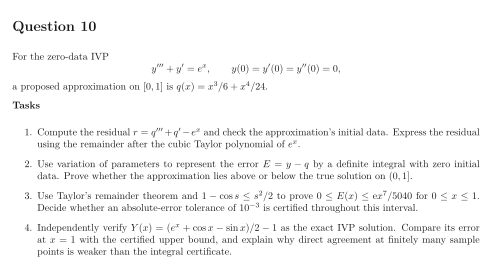
For the zero-data IVP a proposed approximation on is .
Tasks
Compute the residual and check the approximation’s initial data. Express the residual using the remainder after the cubic Taylor polynomial of .
Use variation of parameters to represent the error by a definite integral with zero initial data. Prove whether the approximation lies above or below the true solution on .
Use Taylor’s remainder theorem and to prove for . Decide whether an absolute-error tolerance of is certified throughout this interval.
Independently verify as the exact IVP solution. Compare its error at with the certified upper bound, and explain why direct agreement at finitely many sample points is weaker than the integral certificate.
Show solutionHide solution
Question 10 – Solution
Strategy. Treat the residual as an error forcing and bound its full response, not just sampled values.
Step 1: Compute the forcing error. We have and , so where . The values are zero. Thus has a zero initial vector and satisfies .
Step 2: Derive the positive error integral. For the basis , the variation derivatives for this error equation are . Integrating from zero gives For , both factors are strictly positive. Hence on : the approximation underestimates the true solution.
Step 3: Certify a uniform error bound. Taylor’s theorem gives on . Therefore where the polynomial integral equals . The maximum certified error is , so the tolerance holds throughout .
Step 4: Compare with an exact independent check. For , direct differentiation gives and its initial vector is zero. Uniqueness therefore implies . At , , so the actual error is Numerically, , positive and smaller than the certified bound. Exact evaluation or sample agreement is useful corroboration, but finitely many values cannot exclude larger errors between them. The integral inequality proves the bound for every point of the interval.
See the diagram in the original worksheet below.
